The United States Government officially recognizes three separate Cherokee tribes: The United Keetowah Band of Cherokee Indians, and The Cherokee Nation, both in Oklahoma, and The Eastern Band of Cherokee Indians in North Carolina (our traditional homeland before the Trail of Tears). There are so many Cherokee Indians in Oregon that we can support two groups: one in Eugene, called Willamette Tsa-La-Gi (tsalagi – a way to say cherokee before it got anglicized). The other group is in Portland called the Mt. Hood Cherokees, and that’s the one I belong to. We are affiliated with the Cherokee Nation, who vies enthusiastically with Navajo Nation, taking turns as the largest tribes in the United States. It’s named after Mount Hood, the most prominent volcano on the Portland horizon.
Our local Cherokee group has been having the best meetings lately. I’ll tell you about basket weaving here, and next I’ll tell you about the field trip to view Pictographs. I call them “meetings,” but that’s just the word I use to describe our monthly gatherings. We gather at an indigenous Methodist church in North Portland on the second Saturday of every month, and our Council always has something specific planned for us. Sometimes it’s a show-and-tell, when we bring our Cherokee artifacts, photos, or memories, and talk about what it was like growing up Cherokee. Sometimes we talk genealogy, bringing a list of family surnames, and books of photos and relationships and often people find their cousins! We have played Cherokee Bingo, where we learn the characters of the alphabet and how to write and pronounce the syllabary, invented by our esteemed leader, Sequoyah.

My favourite meetings are when we have a presentation by an expert on something Cherokee. Often, Cherokee Nation sends an expert out to us. In our tribe we have an honorific of “Cherokee National Treasure,” bestowed upon someone who has made significant contributions to the preservation of the tribe’s art, language, and culture. In March, Cherokee Nation made it possible for Cherokee Treasure Barbara Adair to travel from Oklahoma to visit us and teach a class on basket weaving.

The Cherokee Nation sent us this introduction before she came: “An artist of
many talents, Adair has taught basketry classes for well over 20 years. She gathers and
processes honeysuckle, buckbrush and river cane to weave, along with other natural materials to dye baskets. In addition to traditional and contemporary baskets, Adair’s other specialties include making cornhusk dolls, clay bead necklaces and twine bags.”
When we arrived, Barbara had already prepared supplies for us (the supplies were also provided by Cherokee Nation), primarily soaking reeds in tubs of water. In the interest of time, since our meetings typically last only two hours, Barbara had begun many basket starts, which are the small grid of reeds at the bottom of the basket. She said it’s tricky for beginners to learn this, so she gave us a head start.
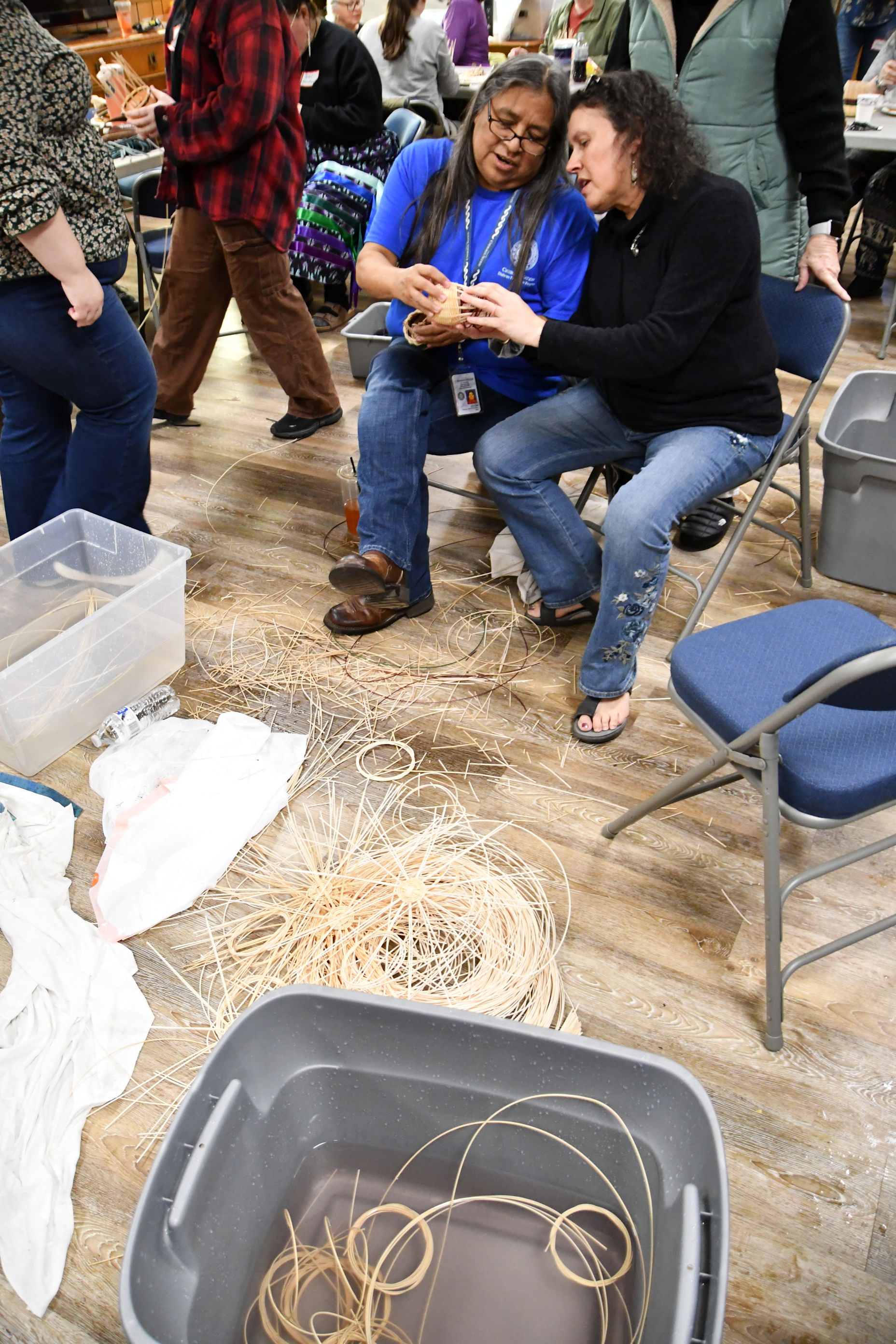
Traditionally, Cherokees wove baskets from flat slices of river cane. First you harvest the rivercane. Then you split the stalks and slice them into thin strips. You color those splints with dyes made from yellowroot, bloodroot, butternut, and walnut. This material is becoming hard to find and for fun projects like this, it’s better to use the round honeysuckle or buckbrush.
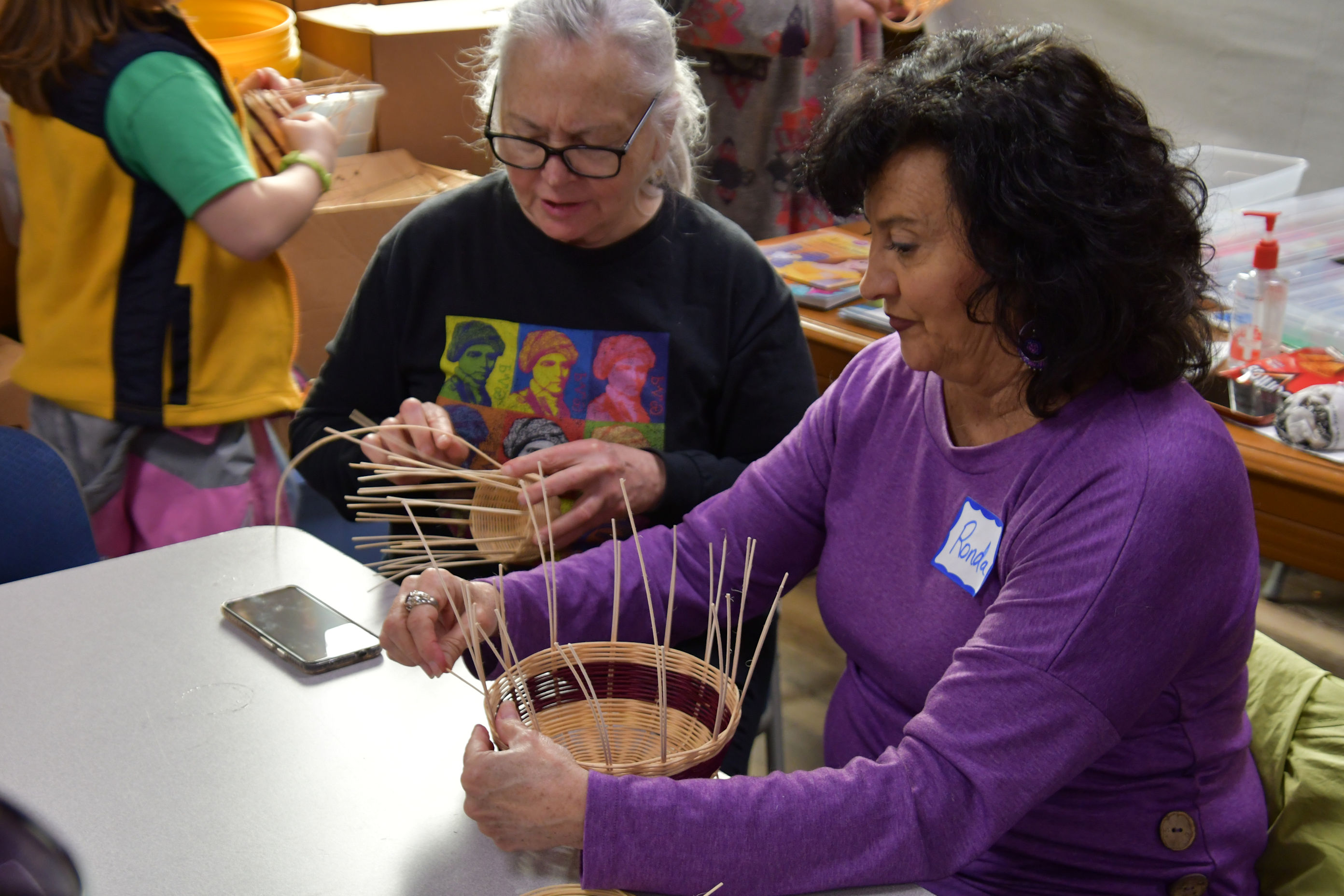
Barbara didn’t spend much time talking or explaining. She was generous and patient and had her full faith in us. She said to grab a spider, and grab a wet ring of reeds, and go back to our seats and just start doing it. Once we began doing it, then we knew what questions to ask and she answered every question.

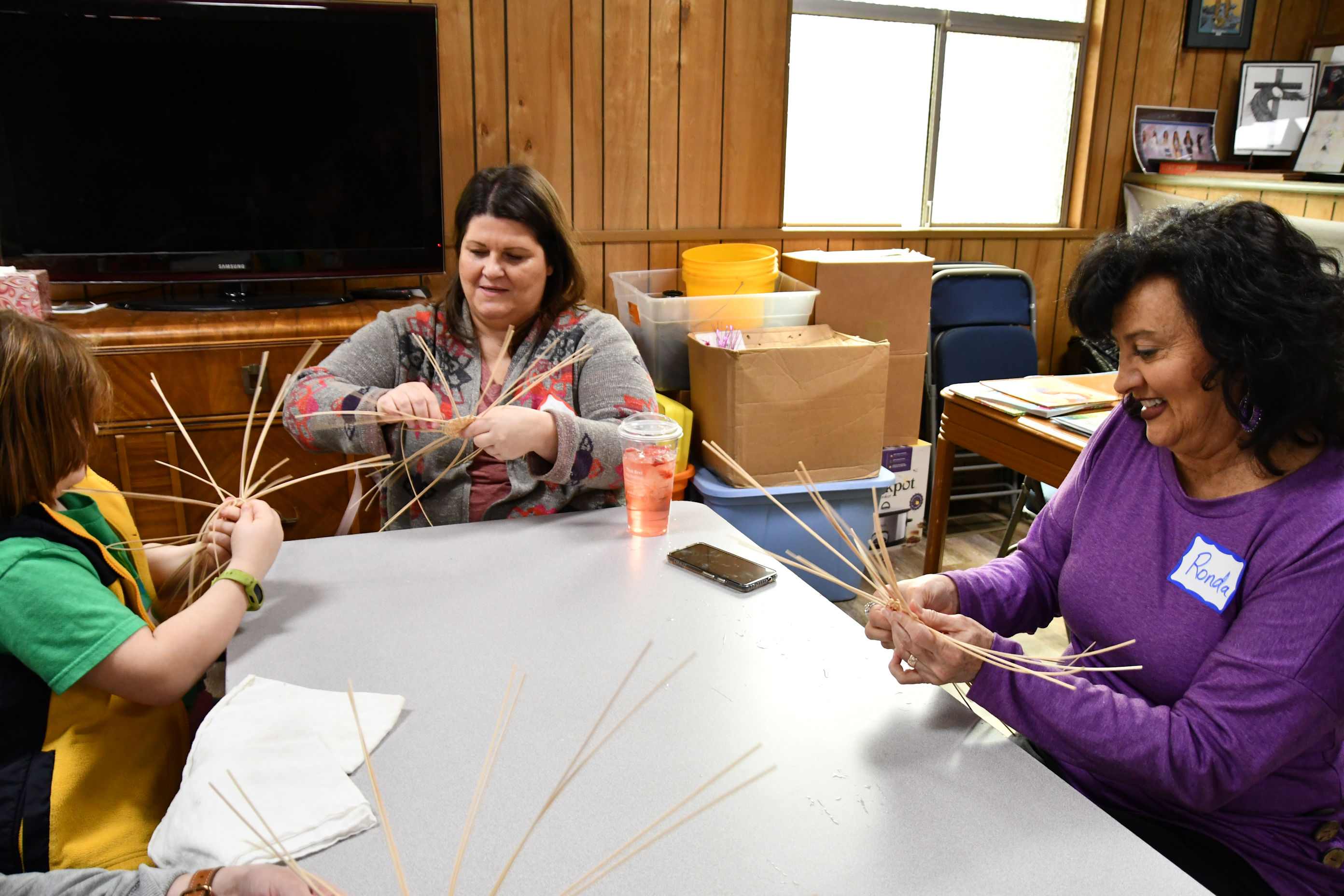

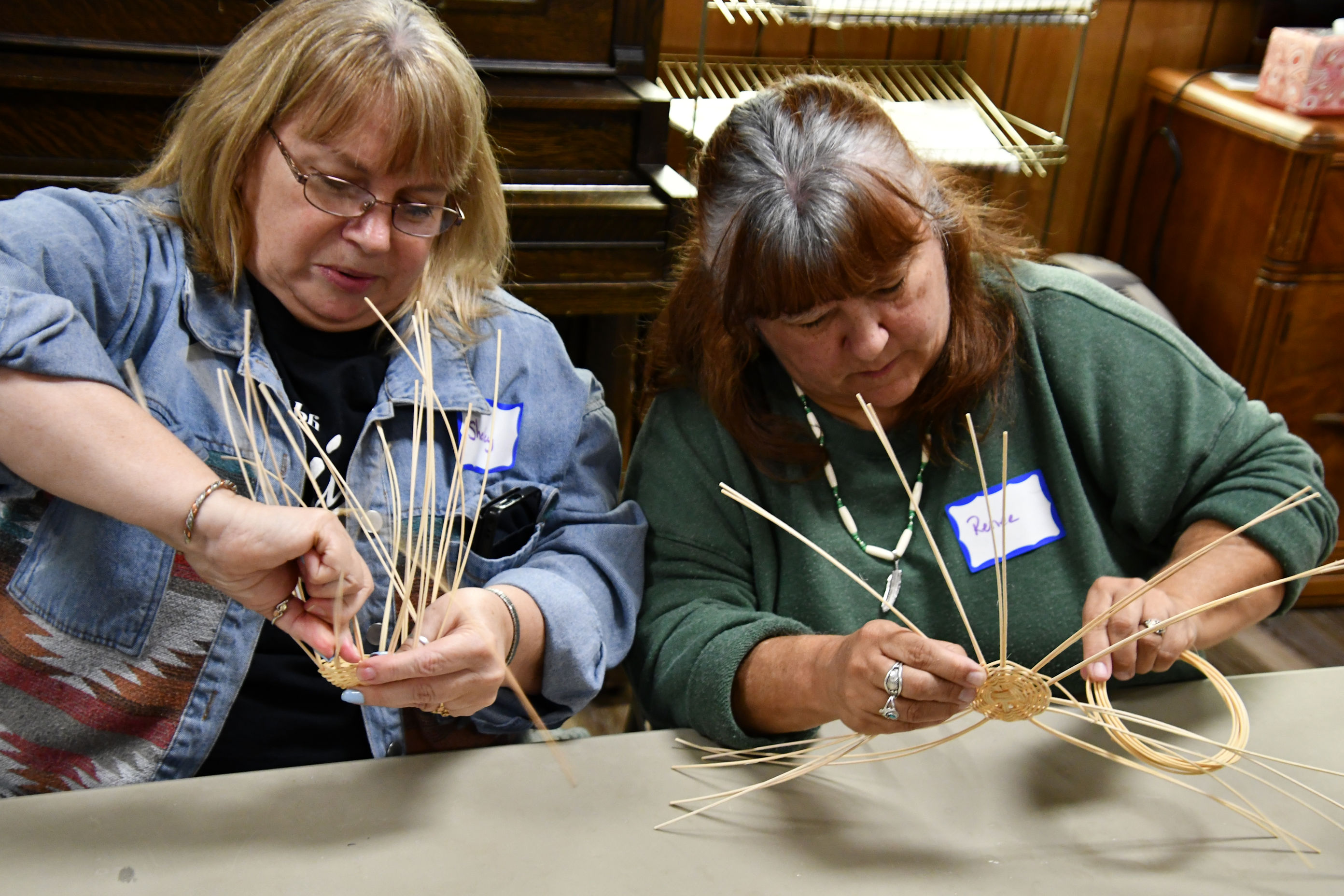

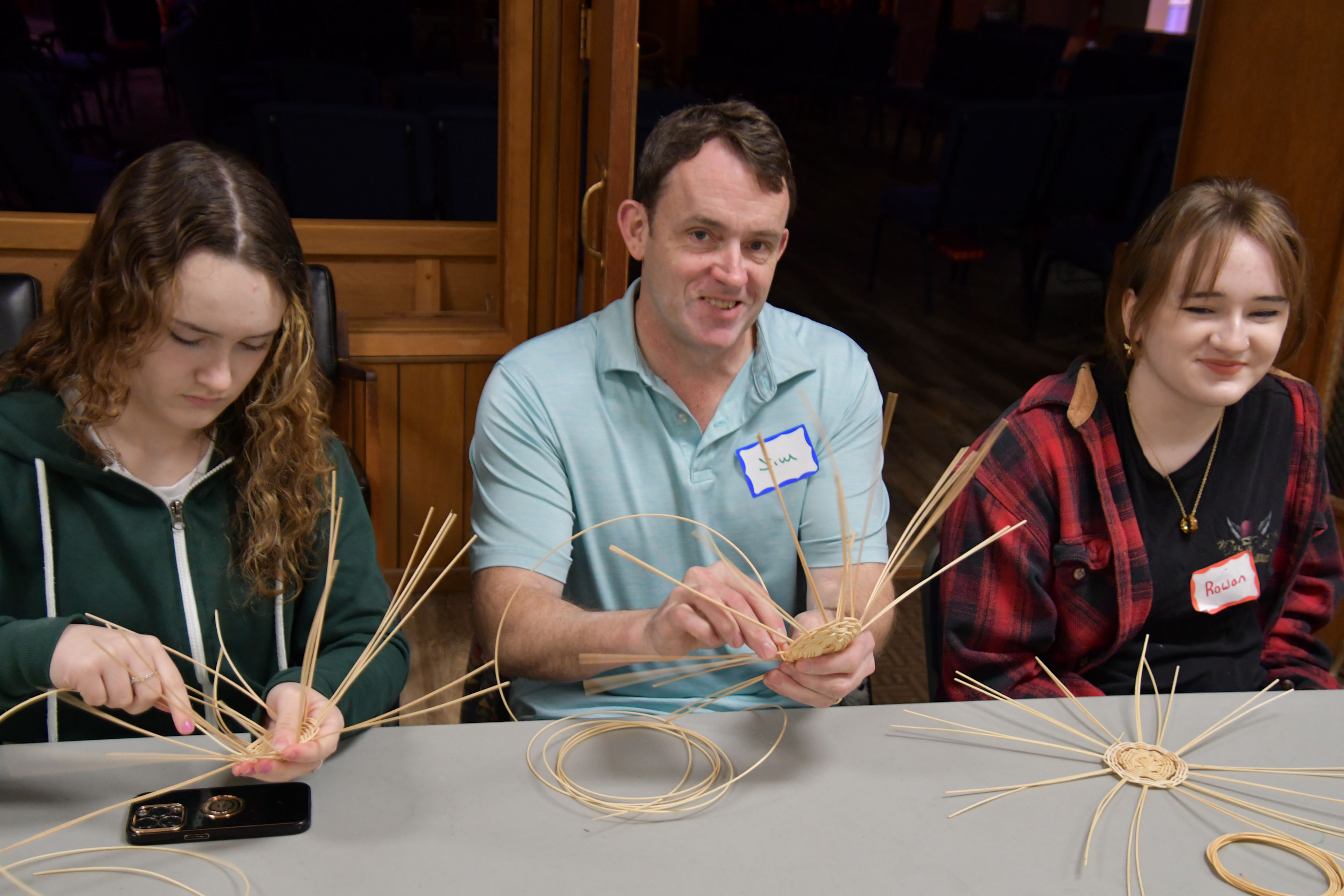
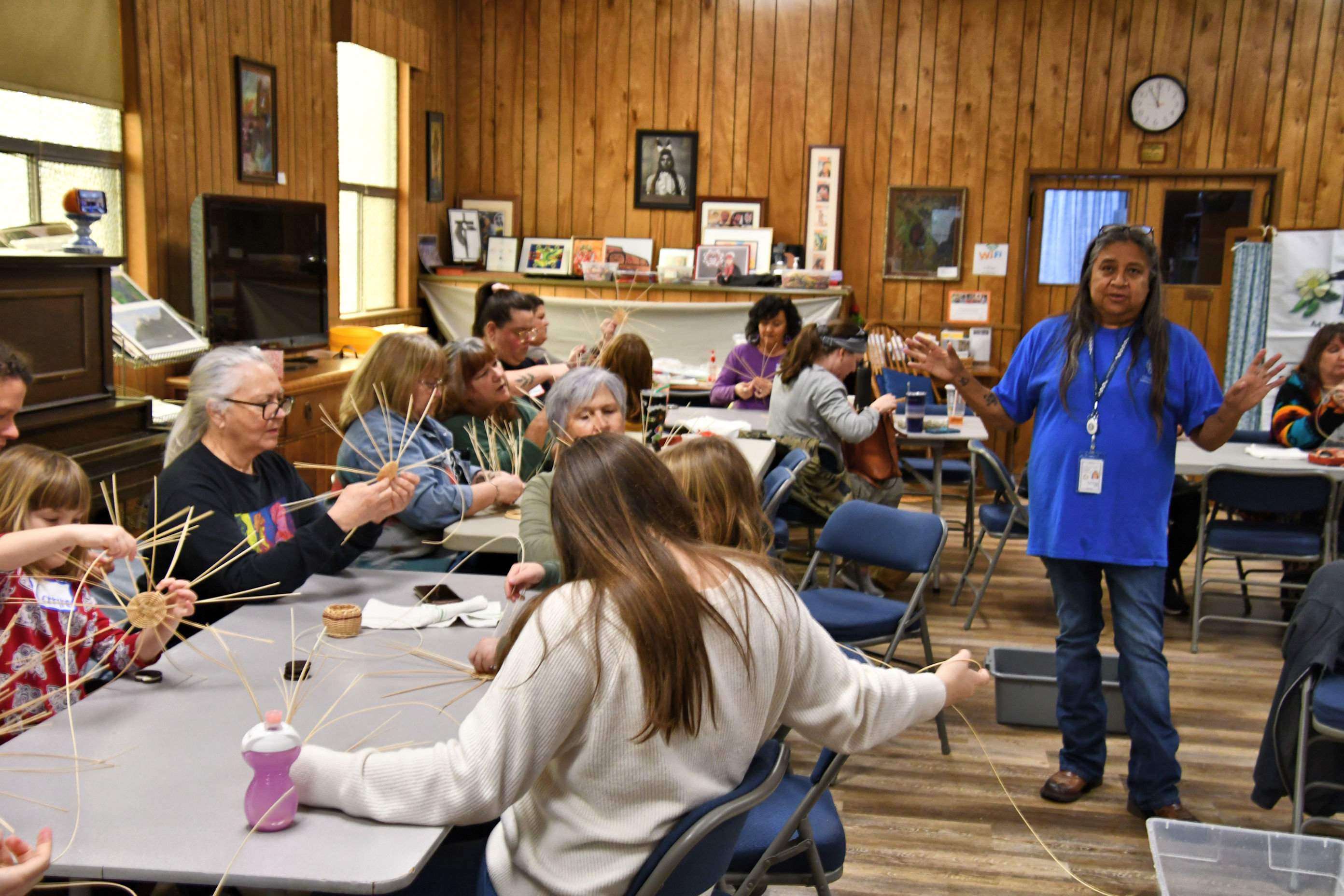

Barbara said that we should periodically get up and dunk our whole project in water again. The reeds need to stay soaked in order to be flexible, which makes it easier for us. Our clothes got wet, and some of us got raisin fingers after an hour or so, but no one complained.
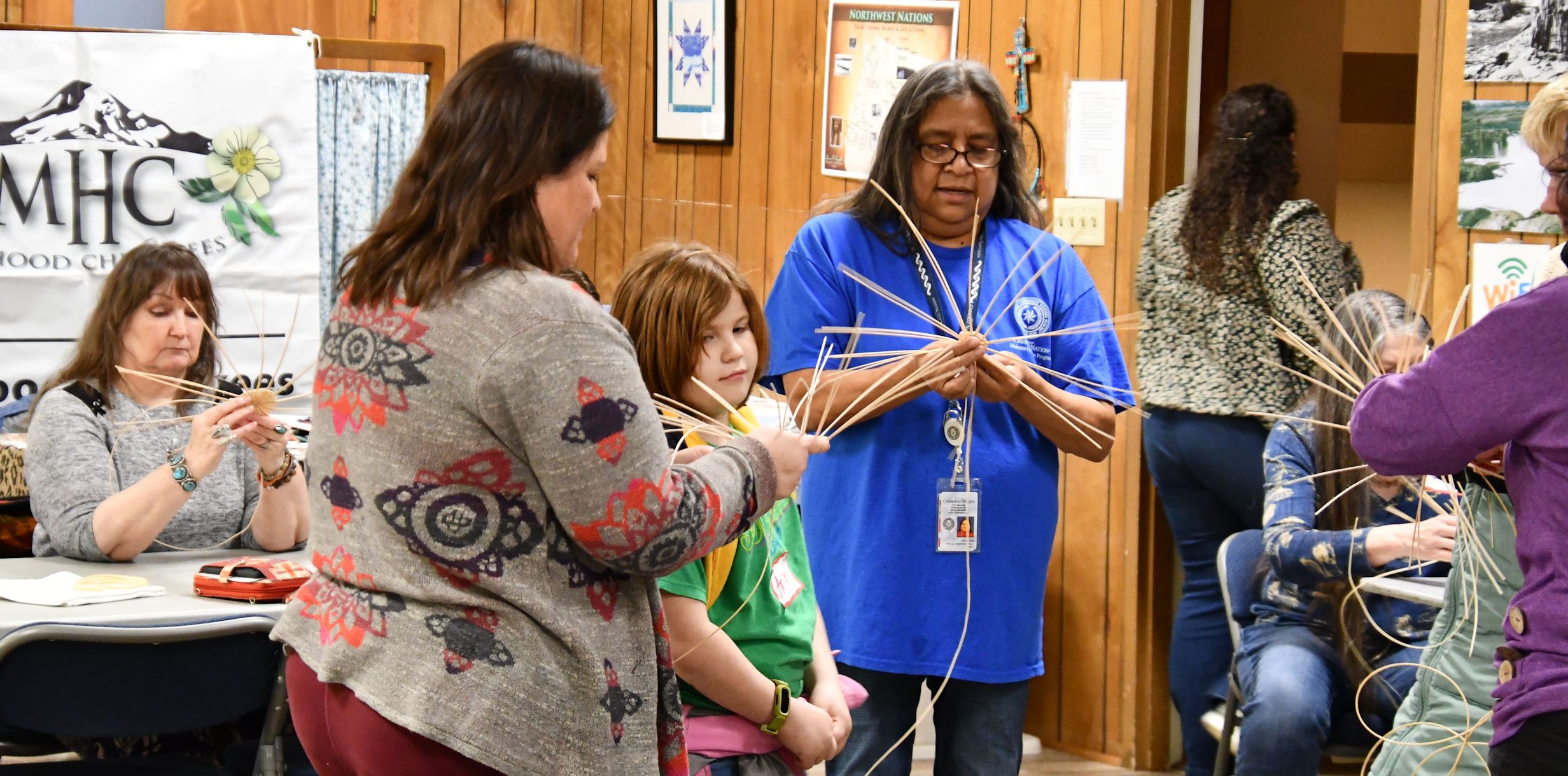
When we made mistakes and brought our projects to her, she would say, “Oh, this is wrong,” and pull out our weaving exactly as if it were crochet. And the reeds were as forgiving as yarn. Simply pull it out till you reach the spot with the mistake, then begin again. After we had a base as large as we wanted, we began weaving the reeds a little tighter, which curved the sides up. This was intuitive. Barbara did not tell us to do it. Some people’s projects curved right away without the weaver doing this intentionally, and some projects remained flatter and broader. In this way, a wide variety of basket shapes began to emerge.
It was fun when Barbara turned our attention to the coloured reeds. Once we knew the basics of weaving, we could be trusted to add colour. To add a new natural or coloured reed, we just laid it beside the one we were about to use up, overlapping an inch or two, and simply copied the pattern of the weave. It was easy to tuck the wet reed ends into any gap to make the outside smooth.


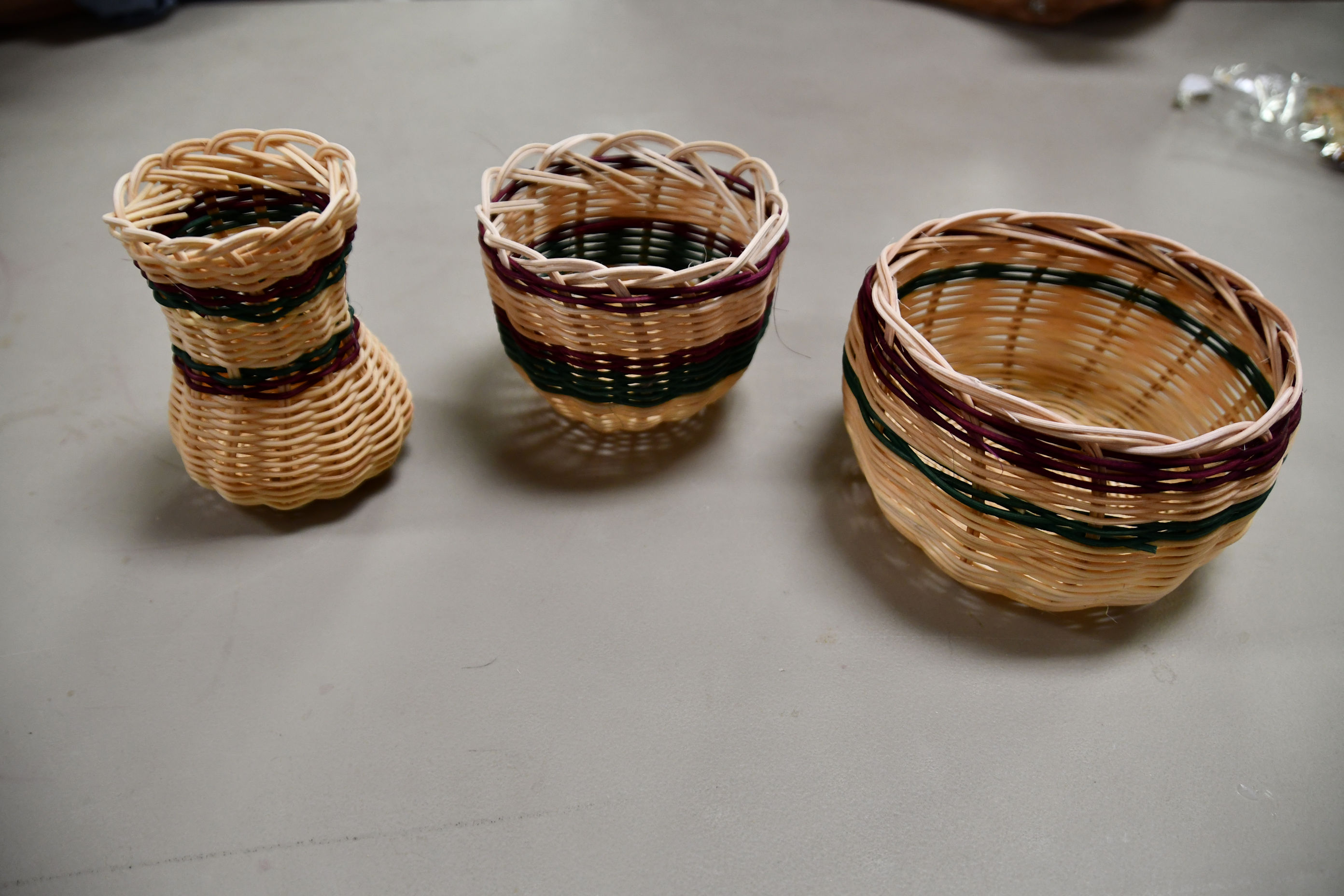
What Barbara taught us is called a “single-wall” basket. This means what it says. We only wove one layer. Cherokees have a unique “double-wall” style of basket making. One of our group had made a “double-wall” basket before, and though our reeds were not long enough to do a large bowl, he tried to re-create what he remembered, for a tiny bowl. Once he wove to the top of the basket, he then folded over the splints and wove back down. I have one shot of his basket.

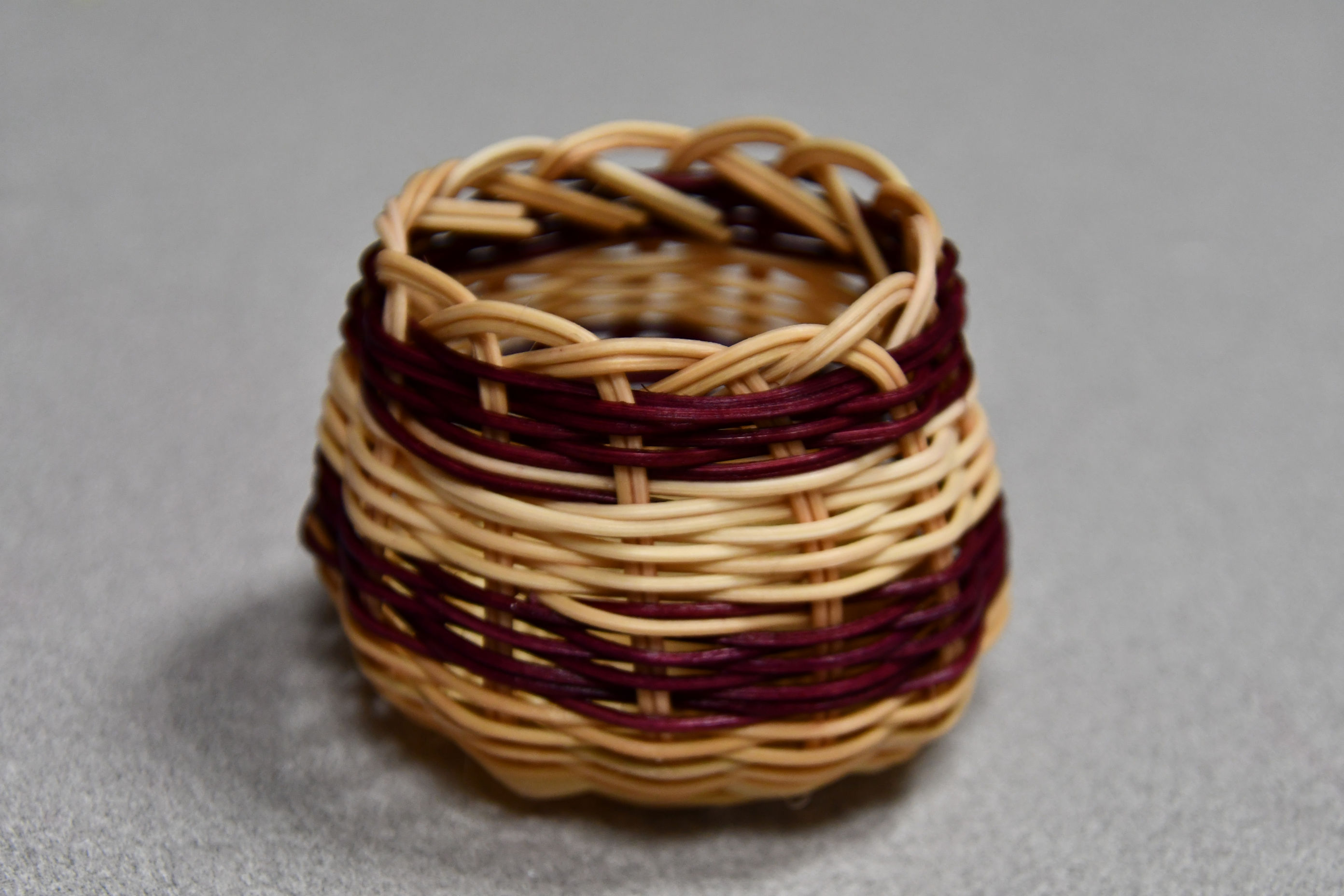


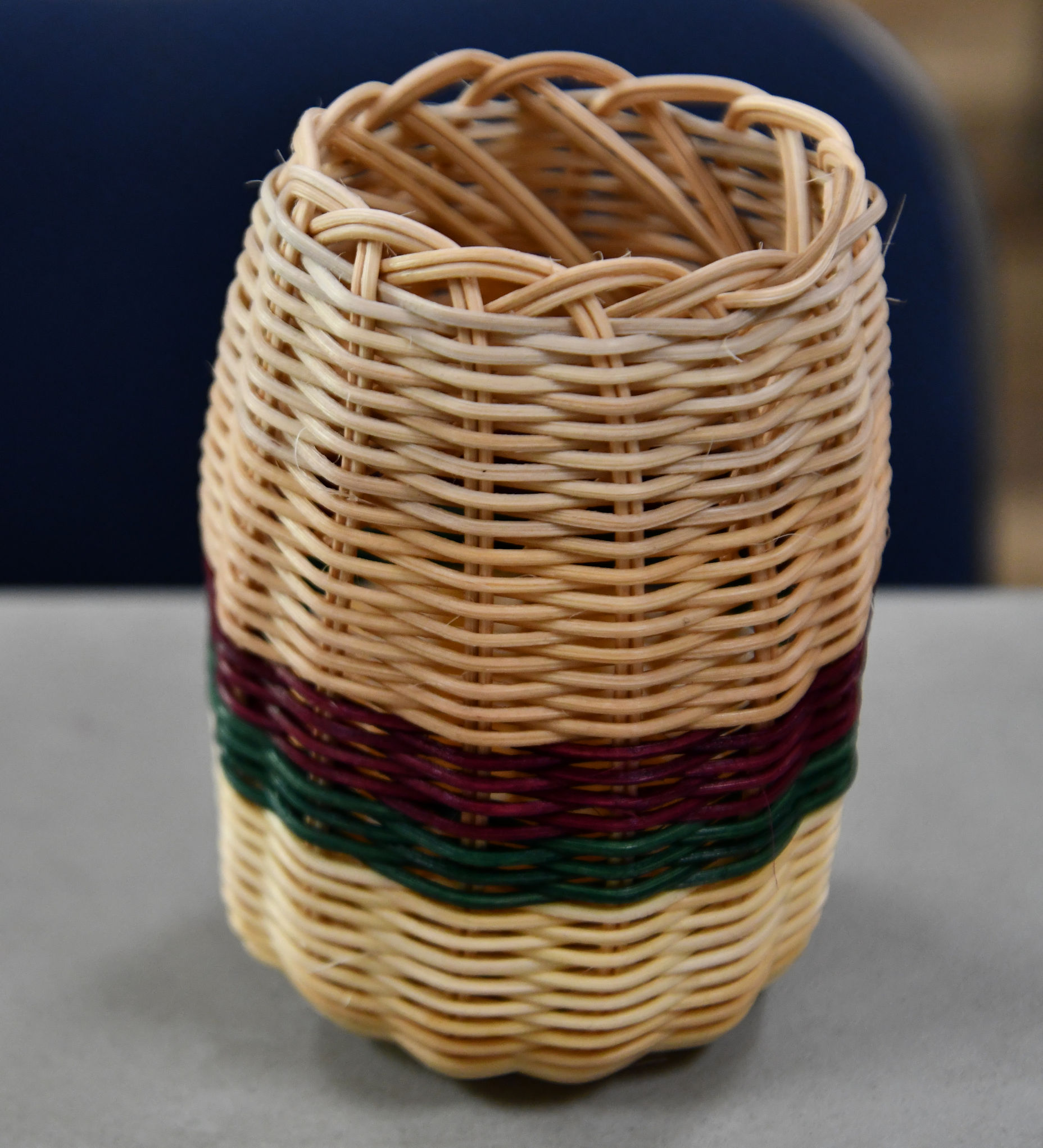

I had fun trying new things, like using a natural coloured reed and a red reed at the same time, to break up the colour. Also, I realized the whole basket is very malleable when it’s wet, so I came up with a creative shape. I think it looks like a hat. I got a little insecure because I was just playing around and not trying to copy any traditional basket shape. In my mind, I thought Someone’s going to tell me this isn’t a Cherokee basket. And then I thought, Well I am Cherokee, and I made this basket. So it is a Cherokee basket. I told this to someone else and she said, “Oh, that’s what Brenda always says to people who challenge her and say ‘But is this really Cherokee art?'” That made me feel good. I love Brenda Mallory’s art.
This project was fun and easy and in 24 hours the baskets were completely dry and sturdy. We were told it’s easy to purchase these supplies online, and several people in our meeting thought they might purchase more supplies and try it at home.

 Conscious Engagement
Best way to have a meeting. I love the line
“Once we knew the basics of weaving, we could be trusted to add colour.” 😂
It’s so dangerous giving information to people with a little bit of knowledge….
👍😁
Sounds like everyone had a great time!
It went well, David. I’m sorry we couldn’t have you with us. Barbara really is a wonderful person. It was the first time I had met her. ❤
A lovely photographic record of the the activities of the day – including your own basket
Thank you, Derrick. I hope I had enough photos so that the process could be understood. Funny how I wished for many more photos when I was trying to put together this blog post, ha ha!
Great post! It sounds like the group is well organized and has terrific gatherings. How long has it been going? Love all the various baskets!
Hi Lenore, thank you! Or, in Cherokee, wado! The Mt. Hood Cherokees were organized in 2009, I believe. I was very lucky and coincidentally came across the group in 2010. I joined right away of course. Then, a few years later, the Council Chair, David Crawford (he commented above) was just randomly calling people to try to get someone to take over the newsletter when the former person couldn’t do it anymore. He called me, and I agreed. I’ve been creating the group newsletter ever since, and it has made me much more involved in the group. Now I guess I’m sort of a fixture there. It has been amazing for me to learn about my heritage this way, since my family never talked about it. I have been able to raise my kid, Kellen, to know about Cherokee ways, and hopefully Kellen can pass it on if they ever have kids. ❤
Your post brought back memories of the one time I worked with a basket maker, and they turned the tables on the anthropologist, and made me try…I did not do nearly as well as you folks did. But it was great fun. Thanks for such great description, accompanying photos!
I’m glad you tried! That’s the perfect step for an anthropologist. 🙂