

Pedro and I just returned from Cayuse country to visit my brother. Ian, and his partner, Karen, recently moved to the city of Walla Walla in Washington state. It’s about 4 hours’ drive from our new home. They moved during October, so they are still getting settled and I can relate to that. For my birthday, I told Pedro I wanted to go visit my brother while I know he is still trying to find his place in their new city.

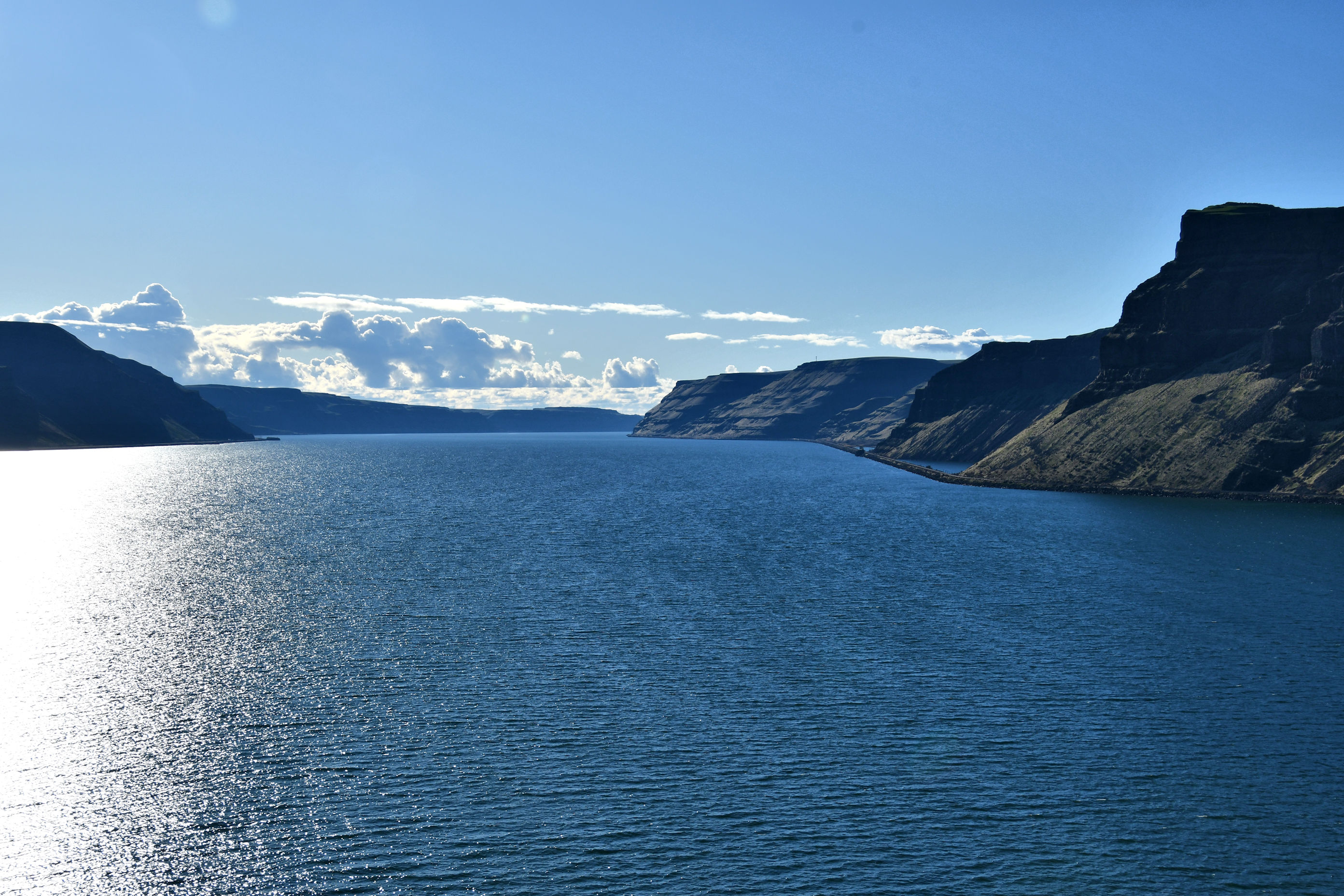
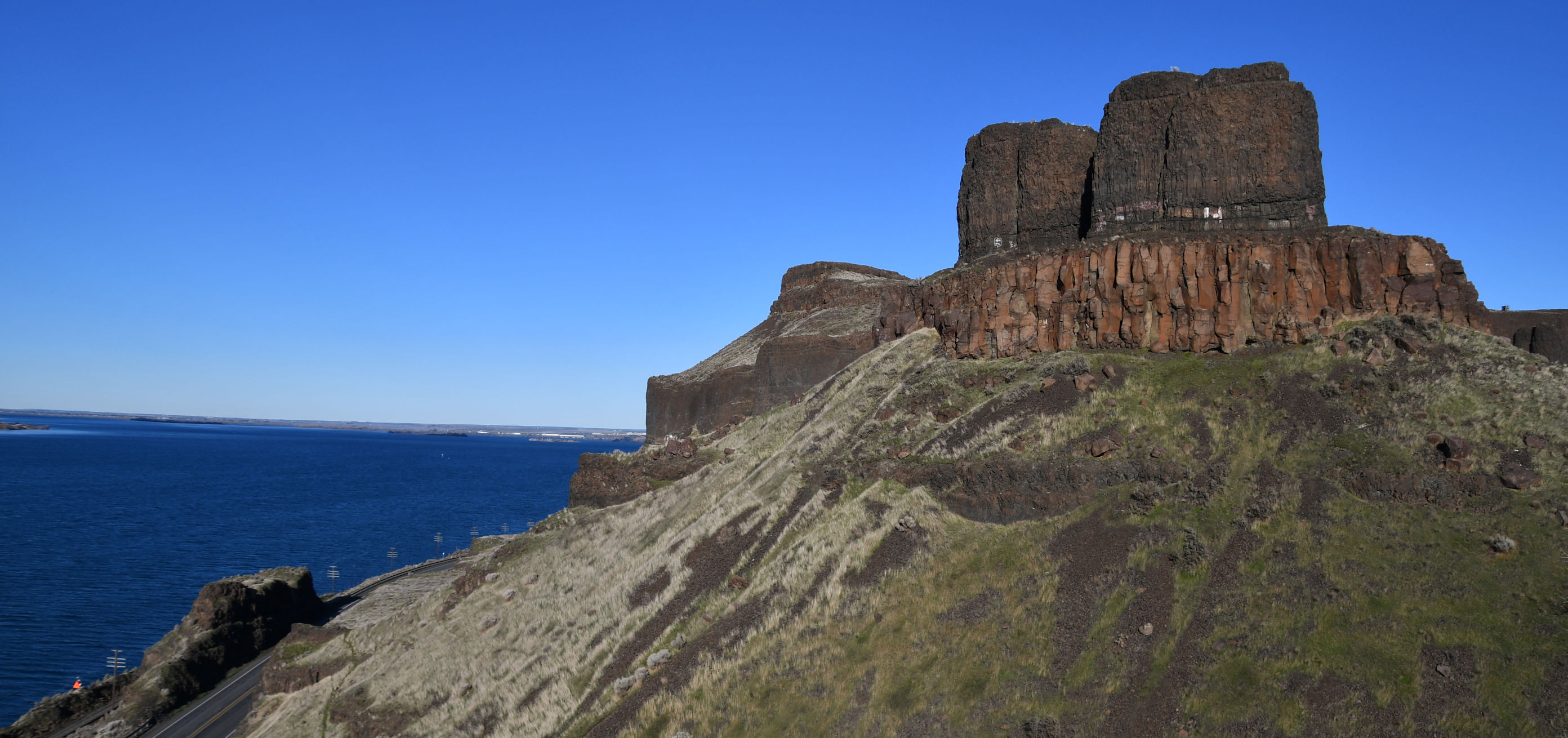
We began in Portland in the rain – to be expected this time of year – and the rain did not let up till we were nearly to Boardman. But then! It turned magnificent for our final hour of driving. We stopped to check out an interesting landmark beside Highway 730 near the Oregon-Washington state boundary. The place is called “Twin Sisters” on official maps, but apparently they have held many names in the past. It’s intuitive that everyone who passed by here in the early days – and there were many – named the formation. It’s on the shore of the Columbia River, which was used as a highway by all the indigenous people who lived here for thousands of years till it became a highway for the first White explorers too, starting with Lewis and Clark.
The formation was called Two Captains (probably after Lewis and Clark), Chimney Rocks, Hell’s Smoke Stacks, Twin Pillars, and Twin Virgins. Apparently that last one contributed to a funny story that may or may not be true. Many people called the rocks the Twin Virgins for a time, and commonly shortened it to just “Virgins.” During this period of time, a Catholic Priest was traveling through here in search of impressionable minds. He was caught in dangerous weather, but at the Virgins he found a cave where he was able to find refuge and it probably saved his life. He wrote to the Church, explaining his story and that caused a ruckus due to the impression that he had broken his vows of chastity. Apparently he had neglected to explain that the Virgins who gave him refuge were actually basalt columns.


The geologist explanation of what happened here is that around 1.5 million years ago there was a huge lava flow that covered a wide expanse. More recently, the Missoula Floods came rushing through this area periodically from 18,000 to 15,000 years ago, carving and scraping fabulous shapes across the land. These icy floods are responsible for creating the Twin Sisters. That is…if you believe in science.
The Cayuse Indian legend explains it differently. I’d love to have an actual Cayuse person explain this legend to me, because it leaves some holes. Apparently, Coyote was walking along the river and spotted three Cayuse sisters hauling rocks into the river and piling them up. {Coyote is frequently found in Native stories, and he remains beloved, though he often causes trouble} While watching them from a distance, Coyote fell desperately in love with all three of them. They piled the rocks to build artificial rapids, which would make it easier to catch salmon. The sisters worked hard all day then left the site to rest. While they slept, Coyote dismantled their work. This continued for three nights and on the fourth day, he saw them crying at the side of the river, out of frustration and hunger.
Then he showed up and offered to build a structure to help them catch fish, but in exchange they had to agree to marry him. They had no choice and Coyote built the structure and fish were caught and they were all married. Old versions of the story claim there is a long, narrow structure of stone in the water near there that is the remnant of what Coyote built, but these days it is likely under the water formed by the McNary Dam. The sisters and Coyote lived happily together until {and this is the point at which it all falls apart for me} Coyote became jealous. He changed two of them into basalt columns, one of them into a nearby cave, and finally changed himself into a rock on an adjacent hill, so he could keep an eye on them forever.

Doesn’t that leave you with questions also? Jealous of what; were they having fun together without him? Were they all three unfaithful with someone? And I get that a jealous magical animal would punish them by turning them into mountains and caves – the animal spirits along the Columbia did that kind of stuff all the time. What I don’t understand is why Coyote also punished himself. But then, he was in love with them, and jealous partners do some pretty crazy stuff.

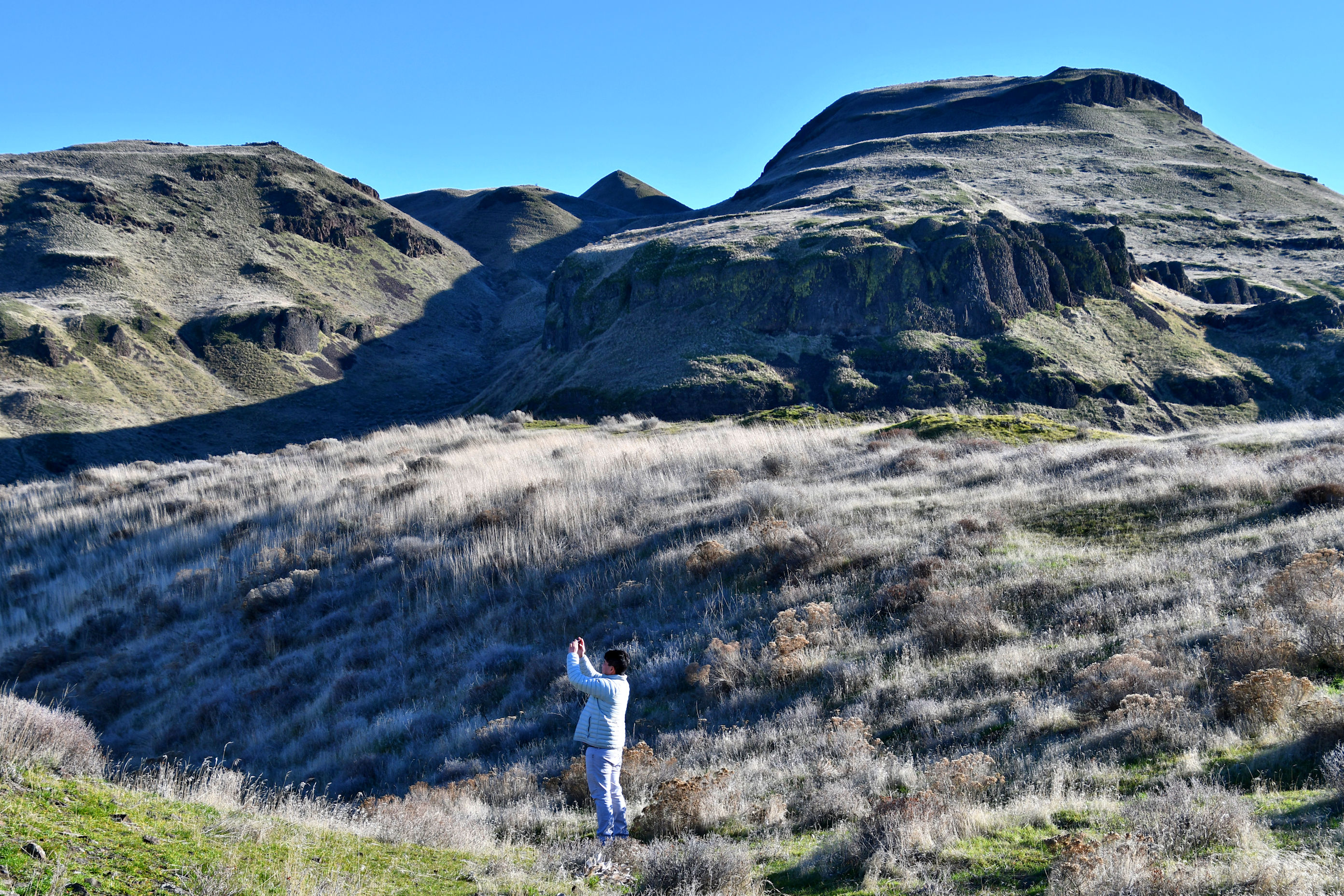
We got out of the Jeep and hiked up the hill to get some awesome views. We did not hike the entire length of the trail, which turns out to be pretty short in any case. Our goal was to get to Ian and Karen. But we did take 20 minutes out of our day to scramble around the hills and take photos. The wind was brisk and the temperatures were crisp, and the trail is steep. In a short amount of time we had pink cheeks and elevated heart rates. It was exactly what we wanted.

 Conscious Engagement
This does need further investigation to why Coyote did what he did. I love a good legend
I agree, Brian. Legends are always appealing to me, even the one about the priest, which may have been made up for entertainment purposes, but it’s still fun to know the story was told. The story of Coyote here drops off so suddenly I feel that some bit is missing. I can’t find the lesson, or the greater value of knowing this story, which one can often find in indigenous oral history.
Australia is full of tales and legends from the old folk. No Coyotes here, lots of stories involve serpents who carved the rivers so quite similar also have women and jealousy involved.
White man in the past tried to stop the passing of oral history but now want to embrace it
It sounds like White people in Australia are opening their minds to indigenous values as they are here in the states, too. I wonder if every group has a trickster spirit animal! My people, the Cherokee, have Jistu – Rabbit. And I know that some groups have Spider. They all seem to have similar characteristics. Now I want to learn about Serpent. Have you written any blog posts about him?
I haven’t as I don’t know the full story and I don’t want to seem disrespectful although you have put a seed in my mind thank you Crystal.
There is so much to learn from the ancients. I just wish that more people would. A main thing that is being embraced is cultural burning, a method of lowering the fuel loads in the bush so the bushfires aren’t as intense
Oh gosh, here too! For both of us, it’s probably because of recent devastating fires. Now wildland managers are investigating indigenous methods of forest management. It’s exciting.
The concept was first mooted and the old timers thought what rubbish. Then the fires came with ferocity now the practice is getting a foothold here. It is exciting
Fascinating
It made an otherwise ordinary journey down the highway a much more interesting one.