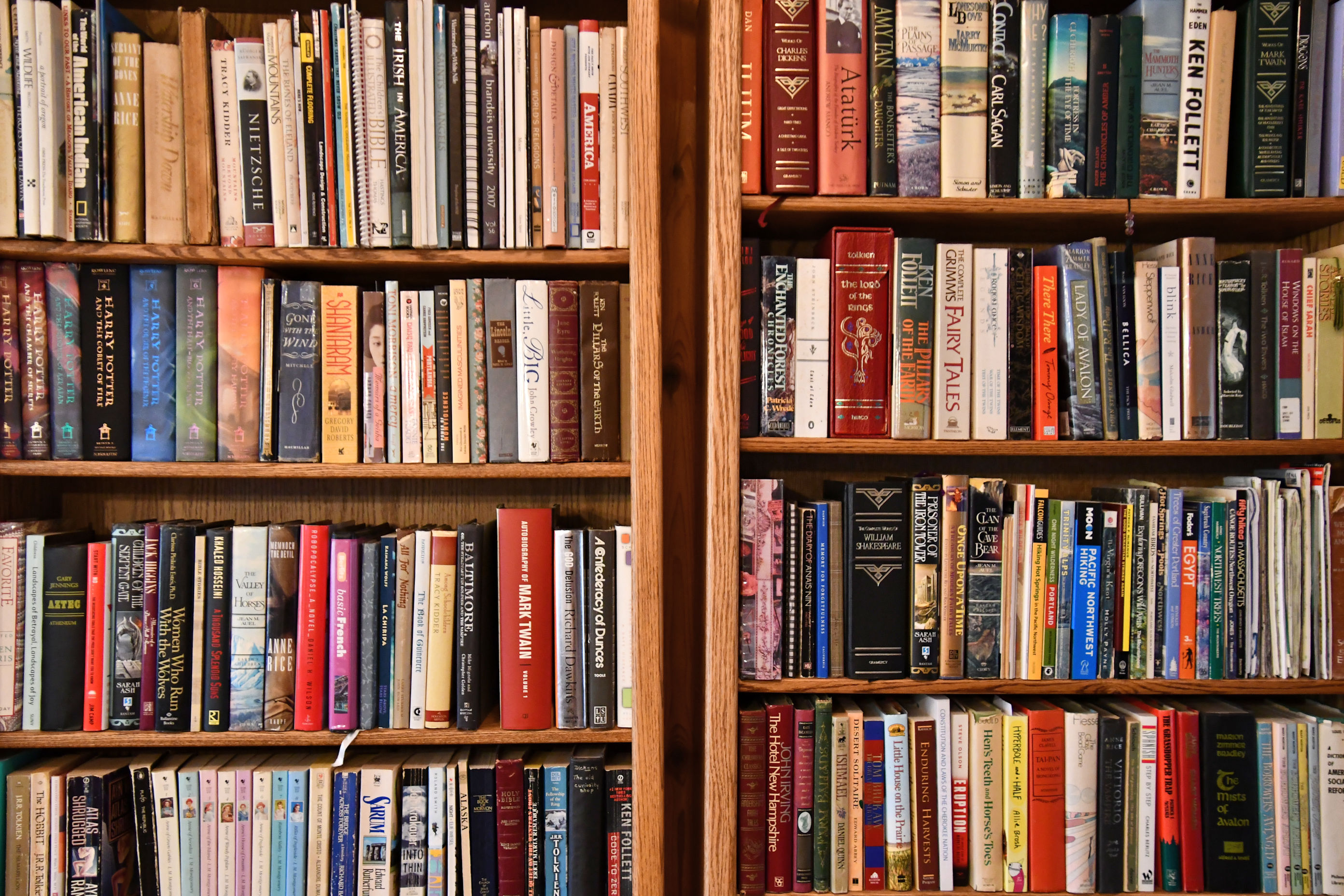
Books I Read This Year

I believe book collections say so much about a person. From these you can glean: curious, irreverent, nerdy

Books I read in 2011
Books I read in 2012
Books I read in 2013
Books I read in 2014
Books I read in 2015
Books I read in 2016
Books I read in 2017
Books I read in 2018
Books I read in 2019
Books I read in 2020
Books I read in 2021
Books I read in 2022
Books I read in 2023
Books I read in 2024

When I initially began this project, my intent was to try to fit more books into my busy life and to gain a little encouragement by seeing my lists grow. It was more successful than I expected it would be, and I have been reading many more books than I expected to be able to. My second goal was to help gain a better breadth of genres, so I will continue to try to improve that aspect. Please drop a recommendation into the comments if you know of a book that should be read!

Full disclosure:

Most of the time I read audio books on my iPhone. I love you, audible.com! Though I value holding a book above all other forms of reading, it isn’t practical in my life.  Always the multitasker, I read stories (and listen to APM, BBC, and other podcasts) while washing dishes, working in the garden, driving, mowing the lawn, going for a run, folding clothes. An unexpected bonus is that I now look forward to folding the laundry and washing dishes! Another bonus is that I am able to enjoy the impressive voice talents of many narrators. It adds an important dimension to books that I haven’t experienced before.

The following are books I read so far this year. If you want to see what I read in other years, hit the links above.

  1. Demon Copperhead by Barbara Kingsolver. I had to put this one on 2024 and 2025 because I was hardly ever finding time to read but also its a long book. over 21 hours on audible.com. This is a magnificent saga of a boy who grew up disadvantaged and privileged in ways that I could easily relate to, and I saw some of his paths similar to mine. Though his story was much more difficult. He was born poor, to an uneducated single mother who didn’t do a good job at mothering. He went into foster care, was abused in multiple ways for multiple years. He became a high school football star, and he honed his talent in making comics. After a life-altering injury, he became addicted to drugs and despite how hard he worked, the drugs just bled him dry. All the beautiful relationships he had built were destroyed over time, till he was only a shell. It’s the kind of thing that can be a crossroads for a person. I continued to relate to his moment of reckoning; how it came to be, what he noticed. Despite its length, and my difficulty finding time to read, it was always engaging.
  2. Erasure by Percival Everett. I read this one because I’ve wanted to see the movie American Fiction, and have not, so this seemed like a reasonable next attempt. It’s a ridiculous but still realistic story. Only 8 hours long, so it was a good choice to get myself back into reading again. The protagonist is an author of painfully aloof and pretentious books. He’s not an ass, just possibly on the spectrum, and writes about what he feels is important in the literary sense and refuses to relinquish his high standards. Then a contemporary author gets a lot of recognition for writing a cheap sellout novel of Black American steroeotypical characters. Out of fury and disgust, he writes one of his own, and sends it to his agent as a joke. The agent loves it. The book gets published as a joke, but under a pseudonym because he wants to be true to his dozen fans, and not disappoint them. It becomes a blockbuster best seller despite every attempt to sabotage that fate.
  3. Essentialism: The Disciplined Pursuit of Less by Greg McKeown. This was recommended to me by my therapist. The book explains the importance of doing less, but doing those few things better. Examples are provided of how doing less is more fulfilling, more helpful, more profitable, more sustainable than we think. Examples are provided of how trying to do too much can cause catastrophe. FYI, most of it is geared toward the workplace and work environments, not so much your personal life in general. I was already on board with wanting to do less, so I wasn’t very invested in all the chapters that were trying to convince me. Some of these examples were interesting, but I really wished the book was about HOW to reduce things in my life more than why I should. The instructions, examples, suggestions on how to do it were not there, or possibly not clear enough for me to be inspired or take notice, and I left feeling more convinced than ever that I needed to somehow find a way to do less. But this book didn’t help me get there.
  4. Children of Time by Adrian Tchaikovsky. I was surprised at how much I was captivated by this book. The author’s premise is so clever and wonderful and wonderfully illuminated. It’s set in a future when Earth predicted its demise with enough time to send out colonizing ships to potential future planets and moons. Ships were then to launch a nanovirus engineered to superspeed evolution to prepare intelligent species to get the planet ready for spoiled Earthlings to then come and habitate the place when the time was right. A civil war on Earth had been underway when one ship launched, and none of the scientists realized that one of their team was an undercover enemy of the scientific plan. The enemy’s big plot was to destroy the mission. Two launches were planned for the prepared green planet: one of the nanovirus, and one of primates for the virus to act on. The primates got blasted out of the sky. The nanovirus safely landed and went to work…on the insects and invertebrates that were there.
  5. Children of Ruin by Adrian Tchaikovsky. Eager to go back to this amazing world and see what happened next, I enthusiastically began book two. The author’s choice to bounce back and forth through time, like in the first book, was more distracting this time. Whereas book one used the same names over and over, through generations, to help the reader keep track of who was who, book two did not use this convention. And the attempts to be as clever as the first one and leave a great secret for the reader to discover, lasted too long and just got confusing for me. I lost my ability to track all the different characters, lost my ability to track what was happening at the different stages in time, lost my interest after a while in finding out what the new secret unexpected consquence of the nanovirus was. I actually read ten hours of this 15 hour book, and finding that I had absolutely no idea what was going on, just quit reading it.
  6. The Attic Child by Lola Jaye. This book tells the painful traumatic stories of two children locked in their own home in the same attic for four years. Only, each was locked up alone, 50 years apart. While Lowra is trapped, she finds some papers with writing, a necklace, and a doll that were hidden beneath boards, but has no idea how they came to be there. The book begins with adult, emotionally dead Lowra as she tries to solve the mystery of the house when she inherits it after a death. On a subconscious level, she suspects that understanding the story of the artifacts will help her have a real life beyond just existence. The audible version has two narrators and both are wonderful: reading one for Dikembe/Celestine, and one for Lowra. I began by explaining Lowra, because I read a review that says her character was too uninteresting. The truth is: the weight of this story is on the shoulders of Dikembe. He lives in a violent time as a child in the Congo, but his parents have protected him from it (they think). When his mother has an opportunity to send him away with a kind, educated British man, she makes sure Dikembe goes. The reader is exposed to the painful, constant disrespect he is subjected to as a pretty plaything as the British man’s “companion,” an object of interest, dragged around society on display, and harrangued for not expressing his gratitude, and lied to about a return trip to join his family. Dikembe wins you over as a powerful, optimistic, courageous, indefatigable man who creates a life out of nothing, and then continues to recreate it each time his forward progress is demolished. Through his story I was educated about parts of colonization of the Congo and slave commerce and racism and Black experience that I didn’t know. Dikembe teaches the reader about love, and that message reaches Lowra. I found that Lowra was written accurately as a woman trapped in a depressive disorder, for good reason after incomprehensible abuse. A reader who can’t understand why Lowra is like that, has not experienced depression, and that’s ok, just don’t judge so harshly. In my opinion, these horrific stories of children trapped in attics is told in a way that I was able to keep reading, though this may not be the case for everyone. Read with caution.
  7. The Collapsing Empire by John Scalzi. Part of why I chose this one right now is because it’s read by Wil Wheaton, and I usually enjoy his acting skills. It’s a fun romp of SciFi politics, which is pretty much one of my favourite genres ever, except maybe Fantasy politics, haha. It’s not a super intelligent story, not that mind-expanding, not that original. But well-written with a few fun characters and no plot lines or characters lost by a careless author, which will drive me crazy. The cursing is kind of fun – but nonstop, so be ready, and the sex is almost as often, but thankfully, no lengthy descriptions of the sex, just references too it. An all-around good story for if you want to just enjoy a book.
  8. In the Name of God by Selina O’Grady. {in progress} I’m having to read this one in bites. It’s good but dense. A very well-researched book about the origins of organized Christian and Muslim religions, with a lot of Judaism because they are all three intertwined. Her main theme tries to be that religious tolerance should not be a goal, because to be tolerated is not to be valued or respected. She tries to use the history of religion to “prove” this. Rather, we should try to understand each other, and respect each others’ similar and different cultures, and live together and let it go. Maybe the idea is to show how organized religions all manipulate people, start wars, commit heinous crimes against humanity, and also bring people together. Since we’re all the same in the main themes, lets stop killing each other for it. My life is too scattered and filled with anxiety day to day, and it’s hard for my brain to settle down and absorb this educational and fair history book end to end. But I imagine I’ll finish it. (Looking up a link for this post, I see that she also wrote: And Man Created God, which is sitting beside my bed at this moment, waiting to be read. I didn’t realize I had seen her name already. I guess I should read that one too.)
  9. High Price: A Neuroscientist’s Journey of Self-Discovery That Challenges Everything You Know About Drugs and Society by Carl Hart. This one talks about the author’s childhood and how it led him to study drugs in America. I only started it. For the reasons listed in 8. above, my brain is just not in the space to read much non fiction I guess.
  10. The Sellout by Paul Beatty. I tried hard on this one, and quit it too. I think it’s well written, witty, clever. But at least for the first 35 minutes, it’s 35 minutes of the main character doing a monologue, I turned it off at that point. A reviewer described it as “savage,” and that’s a good adjective. Interesting and funny, it’s still hard for me to hold still and listen. Maybe when the world isn’t falling apart, I can come back to these titles.
  11. Stardust by Neil Gaiman. I decided to read this after coming home from my first trip to England, since one of the towns we visited was where the movie Stardust was filmed. I have always enjoyed the movie, sort of light and romantic, but more for the lessons therein, of where to place your love and dedication, how real friends behave, how to trust yourself, how to be brave. I assumed the book would be better and it is much better. An excellent classic fantasy, with witches and witches spells, true love, flying pirates that capture and sell lightning, family, tradition, and growing up.
  12. The Library of Borrowed Hearts by Lucy Gilmore. It’s a pretentious and confusing book title for a sweet little romance, so ignore the title. It’s a fun romantic mystery wherein a bored librarian stuck in the basement going through old volumes in order to purge them, notices a first edition classic racy book she never expected to find in that particular town. Chloe decides to keep it for herself, and discovers that, written in the margins, a conversation unfolds between two different people. She gets very invested, and when the messages say the next book to look for, she does a scavenger hunt in the town and actually finds it! This begins her quest to unravel the entire story, which is a nice quest to have, to help her avoid reality of her life, which is raising her two younger siblings on her own, after her mom abandons them, and all the emotional issues that come up for the three of them while they try to get by. Like a Hallmark movie, it’s unrealistic that their awful neighbor Jasper, who has been mean to the children their entire lives, suddenly turns into a gentle grandfather and adopts them all when challenged. The character of Catherine seems much too careless with other peoples’ feelings, but I ended up forgiving her because this, at least, is an unpredictable characteristic/plot twist, so maybe it’s believable after all.
  13. Those We Thought We Knew by David Joy. This one was a tough read, but so good I couldn’t stop. Set in North Carolina and rife with racism: the kind that is undeniable and clearcut, and the larger kind that is subtle and permeates people of all races so deeply that it’s hard to see. The book exposes examples of all of it, in the form of a detective novel trying to solve two difficult crimes of murder and assault with intent to murder. Educational, yes, but also a REALLY good story. It was disappointing that the lovely character development that made me fall in love with Toya, the artist, ends too soon. She comes from the big city to live in a small town with her grandmother and is compelled to challenge the cult of Confederate history adulation she finds there. Her grandmother is very proud of her, and knows how important the work is, though her instincts are to ask Toya to stop. She holds her tongue and sends her off with a smile, and Toya is murdered. About the same time, a police officer is attacked and almost murdered. Two other main characters each take the lead on investigation of these crimes. The dramatic ending is believable as much as it makes you cheer for and despise humanity.
  14. A Room With a View by E. M. Forster. (Click that link to read an actual copy of the book autographed by the author.) I was feeling nostalgic and thinking of my mother’s love for the movie A Room With a View. She loved it so much and I barely remember the movie. There was a scene where the young main character, George shouts loud and long out of joy and freedom (if I’m remembering the scene right). It got me to thinking about how much oppression she felt in her life, and I felt bad for her. I wanted to read the book to maybe get closer to her. I do love old classics like this, and this one was great. Some excellent English propriety out of place in Italy, and characters clashing with each other. The young Lucy so impressionable because she has been told to be impressionable, and her tiresome cousin Charlotte, who seems to remind me of tiresome friends I have endured. The old man is marvelously unconventional, and is frustrated that his son George could be wonderful too, but is painfully shy which stunts his life. The show-off author is also a character I know and can’t stand. All the busybodies reminded me of Jane Austen’s work – so maybe this really was what life was like in those times and places and thank goodness I don’t have to contort in that way. It didn’t obviously bring my mother closer to me, but I did very much enjoy the book.
  15. The Bean Trees by Barbara Kingsolver. This book was recommended to me by a friend. I read my first Kingsolver book at the beginning of the year, and I liked it, so I was game to read her debut novel. It’s a good book – the kind that is just right to kick off an author’s writing career. I identified a bit with the main character, but mainly with her independence and not her experience of unconditional love by her mom. Kingsolver unfortunately uses a couple of annoying Cherokee/Native stereotypes that bothered me more until I realized the year it was published. Taylor and her friends in the book talk about immigration, refugees, Native issues, racism, classism…referring to hateful phrases used right now, today in 2025, and facing issues that are in our news every day, so I thought at first it was a modern book. Once I realized it was published in 1988, I realized that authors were not trying to get cultures exactly right back then. Anyway, Marietta leaves her Kentucky home in a broken down car to seek her fortune and works her way across Oklahoma and ends up in Tucson. On the way, an abused woman hands off an abused child to her, in an attempt to save the child. A bewildered Marietta takes the child and in that way becomes a mother. She stops in Taylorville needing gas, and takes a new name to go along with her new life. Her car completely dies in Tucson and she’s stuck a long time, trying to earn enough money for repairs. By the time she has her car repaired, she has decided to stay. She even goes back to Oklahoma and comes home with the baby legally adopted. This book is kind of like the one I want to write: a character who doesn’t know what she want sort of figures out a path by the end.
  16. Pigs in Heaven by Barbara Kingsolver. The story of Taylor and the baby, who she names Turtle, and her mom and a few other friends continues. I cringed a couple of times about the Cherokee stuff, but honestly, I couldn’t specifically complain about any part of it. It is clear that Kingsolver worked very hard to write it well. I followed, nodding my head, with all the important parts regarding the ICWA, which is also an old story that is still extremely relevant in today’s world. I am so grateful for the reasonable way the problems were solved in this story, and the example of how perceived enemies can work things out with patience and openness. It’s a good story and they work together well as a set.
  17. All Fours by Miranda July.

11 thoughts on “Books I Read This Year

  1. Gee, someone who reads much the same things I do. Would like to recommend a couple of Japanese novels that I absolutely love: “Deep River” by Shusaku Endo and my all-time favorite read, “The Old Capital” by Yasunari Kawabata. I read Kawabata’s novel once a year and always find the writing wonderful. If I ever could write something like that, I would be so happy I would just die. That’s the way my mama would put it.

    1. Thanks for the recommended titles! I find it amusing that you say we read much the same thing, because my tastes are all over the place. but yes, you read Joyce and Kawabata annually, so you are making your case. 😉 I am curious to see what else Shusaku Endo would write, since Silence was so overwhelmingly pious. Are you a writer? Oh, of course you are; you have a blog. I guess I’ll get myself over there and read it!

  2. one of the reads in my life that truly hit home
    I didn’t read it until age 50
    If you haven’t crossed paths with it
    my vote would be don’t wait as long as I did .

    * The Road Less Traveled – M Scott Peck *

    Michael

  3. I was at “Laurelhurst Buds” when I saw the books I read at the top. How have I missed this all this time?? Well, you got me. If it’s funny, I’m all in. I’ll have to get to those last 2. I have the headboard stacked with to be read books and rarely do audio, which I should because I can’t see. 🙂 So now I’ll go back where I started and come back here for more later. Darn, more books. There will be some tech issues to be worked out living down in the hole here but I’ll make it work. Thanks for the reviews. BTW, fingers still crossed. 🙂

    1. Ooh, my 2015 list is so short, too, so I’m glad you found two that you like. Yes, they are both very funny. I have purchased multiple books that claim to be funny, and they usually only rise to the level of “amusing.” These two are FUNNY! I can loan you Hyperbole and a Half after we unpack.

      1. 🙂 Tech support had to rebuild my closet yesterday. The shelf started coming down. Something about too much weight. .;( Tuesday he hooked up his sisters stereo with surround sound and my rails are up the terraces. I’m a very good worker! ( pointer actually) 🙂

  4. Hi CMLove,

    Great set of books. Recently, due to the problems in the US and given my background, I read three books about refugees in Europe from about 1935 -1942. Ground level of a refugee experience. Martha Gellhorn’s A Stricken Field, Anna Seghers’ Transit, and finally Antal Szerb’s Journey by Moonlight. I worked with refugees and IDs for 25 years and what I see now is the same thing that has been going on for hundreds of years. I agree with you the root cause is racism with a touch of xenophobia to spice it up a bit. Also, I am reblogging your recent post. Nice writing. Good luck. Duke

    1. Hi Duke. I just now spotted your comment because I am belatedly updating my 2021 book list. I am sad but not surprised to hear that you have decided that refugees today are created the same way as refugees from any time in history. What’s your opinion of those three books? Would you recommend one over the others? I read a surprisingly chilling YA novel in 2019 called Internment, by Samira Ahmed. Chilling mostly because of how easy it was to believe that the apocalyptical United States portrayed could actually happen in a few years. This chilling reality is why The Hunger Games (also with refugees) freaked me out too. What is it with scaring the bejeebers out of our teens? haha.

Leave a comment