This morning I discovered that my camera battery had run dry. I had been taking photos since I first flew to Annapolis to teach, April 27th. Apprently the camera battery lasts ten days with constant use, which is good, and I had no complaints. All England photos from here on out are iPhone photos.

I had no idea until two days before we met Andrew, that he had previously lived in Stratford-upon-Avon. That made him an especially helpful tour guide. Andrew made the long drive south from his home on the eastern coast of England, to meet Margaret and me in the morning at our Airbnb in Warwick.
Earlier in my trip, I mentioned that I was eager to meet Derrick, a fellow WordPress blogger. Here was the next important reason for being in England: another favourite blogger. I follow/am followed by a big group of bloggers, all at varying levels of history and connection. There are only about ten of them that I really, really like. Only so many that I would travel the world to go meet for the first time. Andrew belongs to that group.
Andrew and his wife Kim travel a lot, and they are the kind of traveller I appreciate. They earnestly engage with a place, talk to local people, learn the history, and explore interesting things that catch their eye rather than blindly do what the tourists are supposed to do. They will take the bus, or rent a car, or walk, to get close to things. They will try out a new restaurant each night and when they find one they like, they go back to it. They make the most of bad weather. Andrew will find something good to say if he can, but if a place simply does not appeal to him, he is brutally honest, and I love that! (Ask him about Cork) He will let you know when a museum was a waste of money, or when you can park for free and walk a short distance to avoid the fee. He laughs when his wife prefers to shop and he prefers history. He is one of those people smart enough to have a keen wit and he’s one of the funniest writers I’ve read, but you have to pay attention to catch the jokes.

Our plan had been to eat breakfast at the pub next door, since the reviews talked about the convenience. Well, they only offered breakfast on weekends. So that option was a dud. We had leftover fruit in the Airbnb, and ate that instead. Margaret sat at one of the picnic tables in the photo above, and I walked to a coffee shop nearby to get our coffees.
I stumbled across Andrew’s blog Have Bag, Will Travel around New Year’s 2015, and we looked at each others’ blogs, then sort of never wandered away again. And here we still are after a decade. When I saw a man get out of his car at the end of the block, I recognized him instantly and waved. We went right back to the shop nearby to get Andrew a tea.
I decided that since we would be there a few minutes, I would buy a pastry. Reading the signs on the glass, I asked the man behind the counter to tell me what a “bap” is. He responded that it’s like a “cob,” which I also needed defined. “A bun?” he suggested. Aha. I knew what a bun was. As English biscuits are to American cookies, a bun was probably not what I expected, but it was much more helpful than bap (a whack to the head) or cob (what corn grows on).


Shakespeare, his parents and his children were all born in Stratford-upon-Avon. The man himself is supposed to have been born in April 1564. I assume you are all familiar with him, because he is the most famous and influential English language writer. Andrew explained why. Shakespeare, the Bard of Avon, hasn’t been the only excellent writer of earlier centuries, so why is he far and away the most famous? Because he was possibly the most liked. In his time, it was not customary to print plays. After his death, his friends and fellow actors worked together to compile all the plays they could remember, and published those. Talent isn’t enough to influence the world, you also have to have friends. It’s a good lesson.


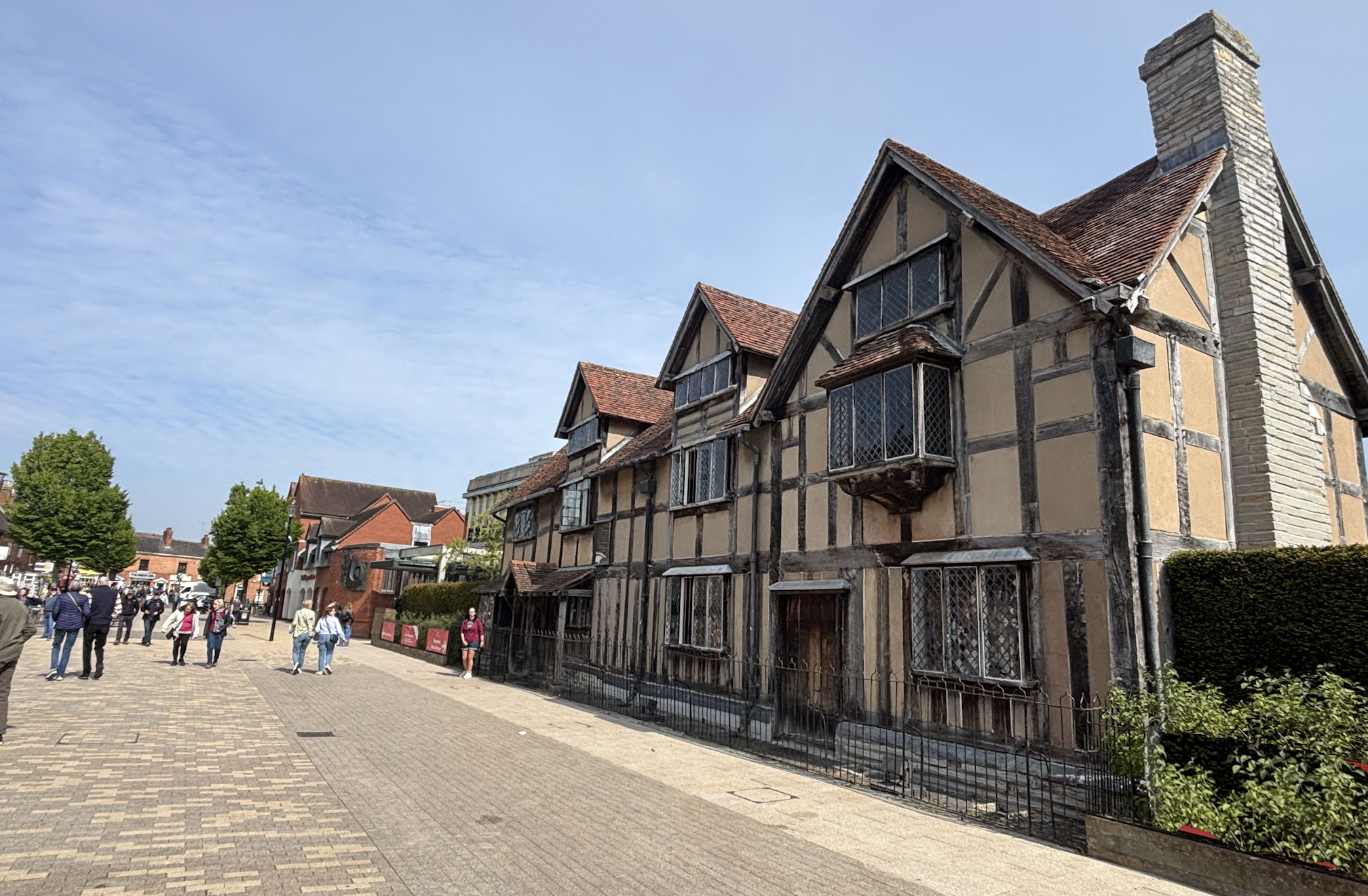
A building caught my eye and I was taking photos without realizing that we had walked right up to Shakespeare’s birthplace. I didn’t even realize it would be here! Prior to the trip, I wasn’t clear on the details of why this town was associated with Shakespeare, but had always assumed it was his main home while he was a playwright. Even that appears to be wrong, as – in the 16th century – it was better for his career to live in London, which he did much of the time. But right here, in the center of the town, was the preserved home the Bard was born in, and grew up in. It was gated and closed. From the street, it looked sufficiently old and I was impressed.

We continued to explore the lovely village, walking street to street, following Andrew’s suggestions.


We walked down Sheep Street and I was able to make purchases of a bag to hold extra things I acquired on the trip, and also sweets from a candy shop to get treats for the twins, who had asked for some kind of candy that was traditional to England. I used Andrew’s and the shop keeper’s help choosing. I purchased a bag of mixed hard candies and some multicoloured sour puff candies that melt in your mouth, and then my shopping was done. We next walked to the famous River Avon itself.


Andrew asked if we wanted to see the theatre, since we were there. We agreed.

The beautiful modern theatre is on the banks of the river and is a memorial dedicated to Shakespeare. The Globe Theatre, that became famous as his home theatre, is in London. We walked in and asked if we could take a peek inside the theatre itself. We were told we could not. It was worth a try!

We made the short drive from the river just outside of town to Wilmcote and parked near the beautiful old farmhouse believed for hundreds of years to be the home of Shakespeare’s mother. Shakespeare Birthplace Trust bought Mary Arden’s Farm and transformed it into a place to educate and delight primary school children. Andrew said he had fond memories of visiting here on multiple occasions.

The name of the operation is Mary Arden’s Farm, but the building has been renamed Palmer Farm. In the year 2000, someone thought to date the wood beams used to build the home, and found that they were too new to have been around at the same time as Mary. For a moment it was thought that Shakepeare’s mother’s home was lost forever. I can’t find an explicit description of how much longer it was till another home was found, but the story turned around rather quickly. Wood dating was performed on other buildings owned by the Shakespeare’s Birthplace Trust, and miracle of miracles, Mary Arden’s actual home was found again! This time, researchers were careful about it, and found records that showed her grandfather had purchased and built the home – now a museum – that is truly the home of Shakespeare’s mother.

Andrew was hoping for a tour here, and disappointed to find that this place was closed. It no longer opens to the public, and has re-envisioned itself as strictly a place for educating children. We peeped over the fence and looked toward the barn area in the back, and indeed saw a group of children. We climbed into the car and drove off once more.

Back we went to Stratford, where, on the outskirts of town we arrived at Anne Hathaway’s cottage. For as much as people love this family, there isn’t much known of them. Records were slim then, and no one at the time knew that in 2025 we would still be fascinated with all things Willie. Rumors have spun about the bad marriage between Will and his wife Anne, based on speculation using incomplete data. The playwright spent a lot of time working in London, and left his wife and children behind, which made him seem like he was neglectful and maybe didn’t even want to be home. Furthermore, in his will, he specifically left his “second best bed” to his wife, which seemed like a hurtful slight to some.
Thus, it was with satisfaction in some historians’ minds that in April of this year, an article was published regarding the fragment of a letter that had been found addressed to Mrs. Shakspaire by an unknown author, and places her in London. The letter asks her to use funds set aside by William for an orphan boy, assuming their partnership on such matters. It is entirely possible that they had a loving and successful marriage, and were not separated as much as believed. And the bed thing comes up again too.

We parked on Cottage Lane, and walked a short distance to Anne Hathaway’s cottage, the place where everyone is sure that Anne grew up and where Will certainly would have visited to court her before their marriage when he was 18 years old. This time, we were able to enter and have a tour!

In the lobby I found one of those machines that will smash a penny for you, with the image of something pressed in. I collect currencies, and somehow it includes what I call “smashed pennies.” This would be the first in my collection from a currency other than US. I included a photo of my smashed pence at the bottom.


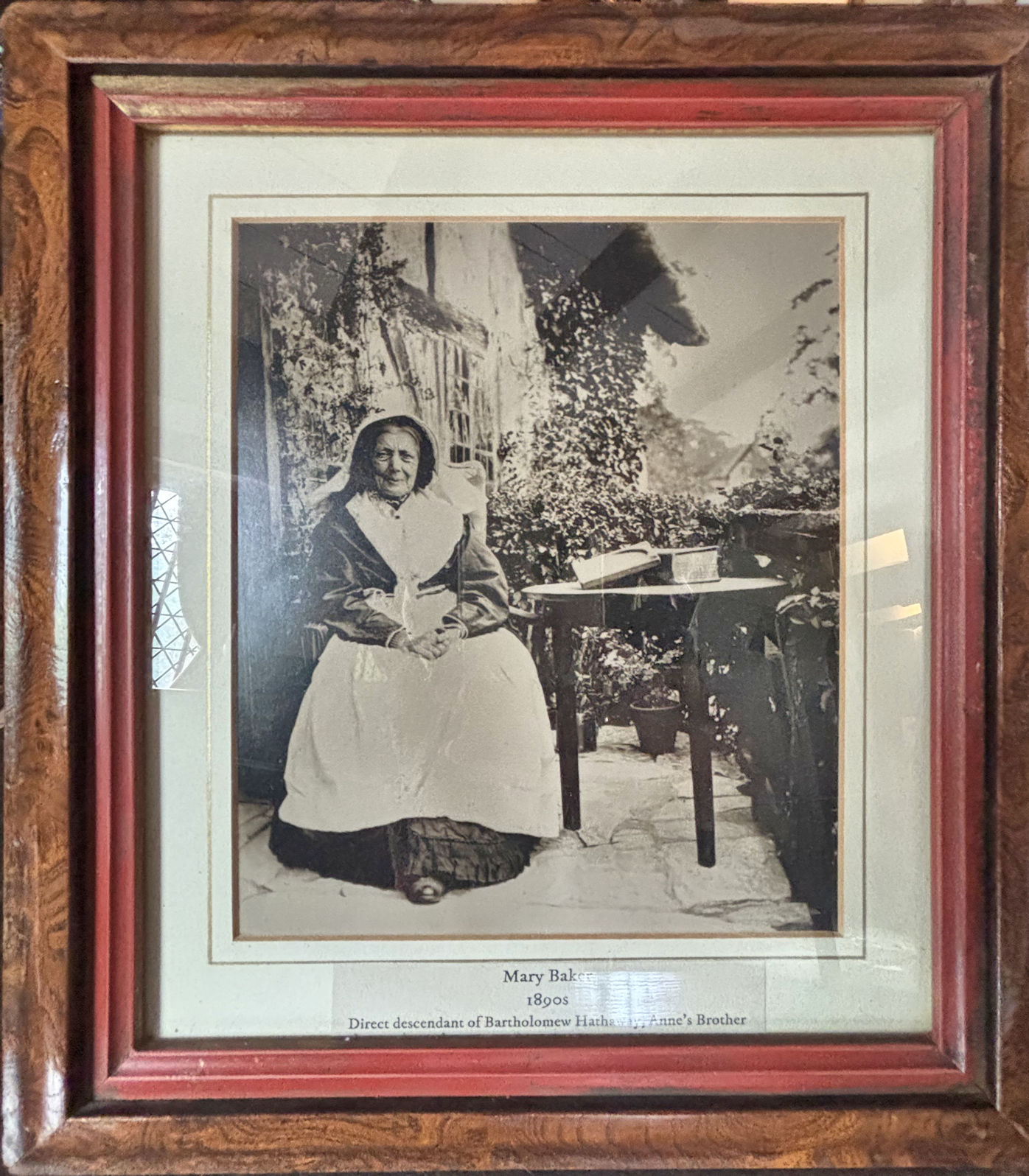
The home was built in 1463 as an open hall. The original portion is the lower section that you see on the right. The first Hathaways that lived here were sheep farmers. In 1556, Anne was born here, and in 1582, she married younger William. In 1620, Anne’s brother, Bartholomew, bought the lease to the property and began developing it. Fireplaces were added, the open interior was turned into a first and second floor, and an extension of the house was added, doubling its size.


Our guide told us that this bench in the home is one that Mary ‘Hathaway’ Baker and other Victorian Hathaways claimed was where William wooed Anne. After regaling Victorian tourists with romantic stories of the courtship, Mary Baker would produce a knife and offer to carve a small piece of the settle off as a souvenir for a sixpence. The bench is not old enough for the story to be true, but old enough that its real story makes it a cherished artifact.


The house is fully furnished, and visitors are allowed to examine nearly every bit of it. We were kept behind barriers and watched over by docents much of the time, so we looked from a distance. That is best. You really can’t trust the public. 🙂


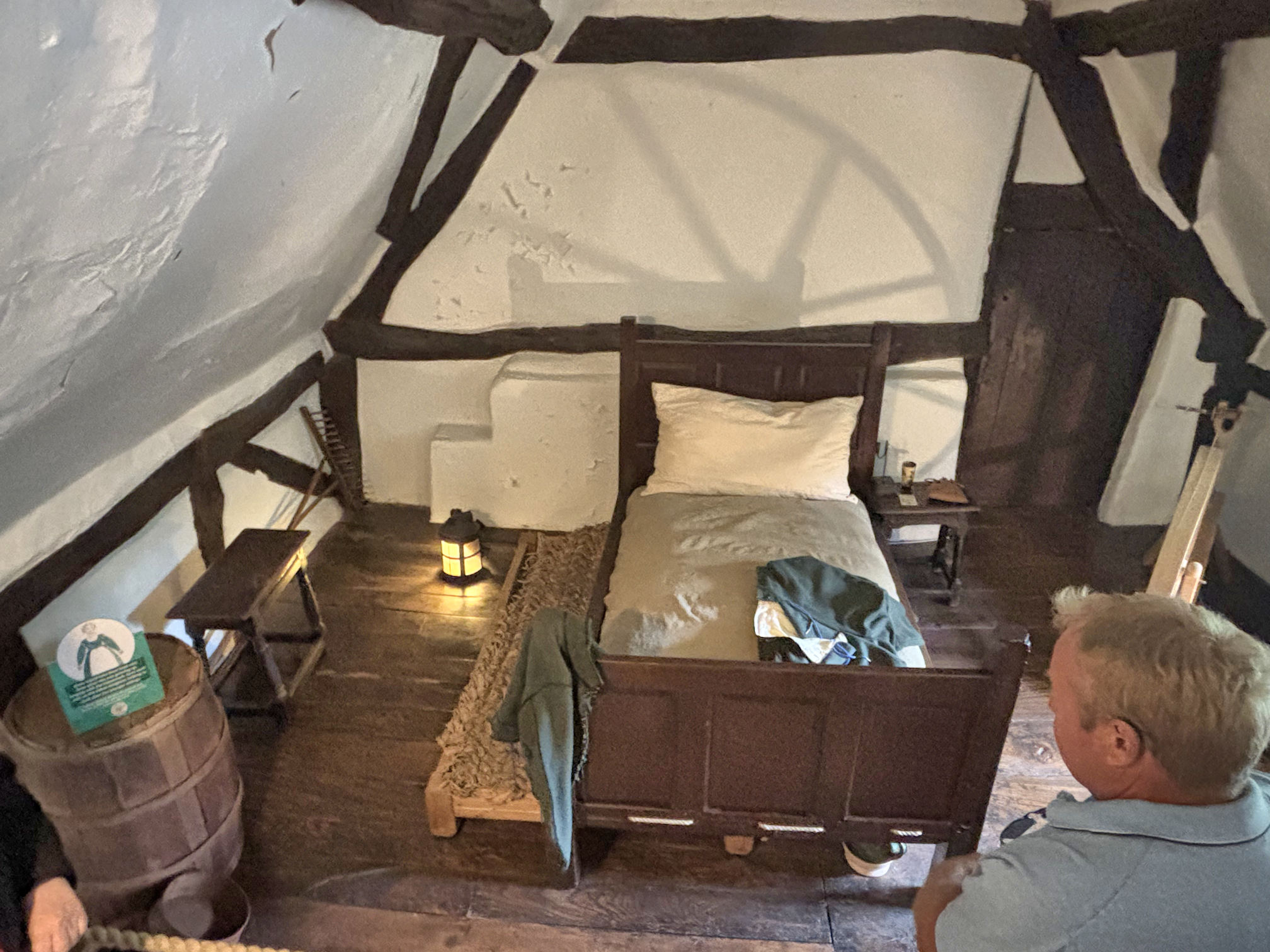
Speaking of beds, said the tour guide. And she explained about the “second best bed” fallacy. Wives weren’t always looked after in wills, for one thing, so Shakespeare specifically made sure she inherited. Beds were expensive, and part of a family’s wealth in those days. To make sure she had a bed was a good thing. The best bed in a home was not one that was used by the family, but saved for guests, and would have been installed on the ground floor to be in full view so as to impress house guests. The second best bed, would have been Will and Anne’s marital bed, and the place where her children were born. Of any bed in a home, this one would have been the most special, the most romantic even, for a wife to possess.


Andrew was the one who got the tour guide started. He said there was a common phrase…she cut him off and said it wasn’t accurate. He tried a few times to get her to tell us anyway, but she stood her ground on historical accuracy, and so I don’t think the phrase was ever spoken, and I don’t know what it was. Andrew does though. 😉 Anyway, she said she could share some common phrases that we can take from this period in history.
For example, she said, back in the 16th century, people had personal wooden plates called trenchers and they were usually kept close by. When a woman married, they would take their trenchers, or plates, with them when they went to their husband’s home. When a woman was a spinster, it was said she “left her plate on the shelf.” Well. This one was a dud. None of us was impressed because we were unfamiliar with the expression.
The guide racked her brains for the next one and then told us about how rodents liked to live in the thatched roofing, so pet dogs and cats were encouraged to spend time on roofs, in the hopes that they would catch and kill the vermin. This was all well and good till there was a particularly bad rainstorm that would cause the thatching to become slick. During especially heavy rainstorms, it would “rain cats and dogs.”
Andrew and Margaret moved on while I lingered to ask more questions.


She finally thought of two more that I thought were the best of all, after the others had moved away. See the ropes strung through the bed frame in the photo above? These ropes are what held the bed platform together, and after much use, the ropes had to be tightened to keep a comfortable bed. That is how people came to say, “sleep tight.”
When I pointed to the lumpy bed (it’s hard to see in the photo above, but the farthest side of the mattress has a high lump while the closest side sinks down) and asked what the mattress was made of. She said the tick mattress was a sack stuffed typically with hay or straw, and after sleeping on it for some time, the stuffing would pile up and become lumpy. One would take a stick and beat the sack until the stuffing was level again. You have already guessed the expressions, haven’t you?! Hit the hay, and hit the sack both became euphamisms for going to bed.

I was delighted to have learned so many more expressions this day, from bap to hit the hay. The plate on the shelf one will rest in my mind and hopefully I’ll hear it or read it somewhere, someday.
We were all hungry and Andrew knew exactly where he wanted to go, since he had been there in the past. We walked down the street, around a corner, and went into the Bell Pub and had a hearty lunch.

On the way out of there, Andrew graciously stopped for me to acquire two more thatch photos, on a cottage very close the the Hathaway Cottage.


The fox had caught my eye. Andrew explained that the animal on top is usually the calling card of the thatcher, and I think he said it’s often a fox or a pheasant. I had seen a few on this trip, and was happy to finally have the opportunity to photograph a straw finial.
Andrew drove us back to our Airbnb in Warwick and at the very last moment I remembered to ask for a photo. I couldn’t leave England without a photo together with my friend.

I sent this photo to Pedro and he asked, “Is that Andrew’s house behind you?” Nope. He was about to embark on a three-hour drive back home, in advance of an international vacation.

My friend Andrew was not entirely who I expected. His online persona is a cantankerous yet endearing curmudgeon. But no!! The real life Andrew is a pure, good man with a gentle and generous heart. He was kind, and thoughtful, and attentive. Consistent with my expectations, he told great stories, was quick to laugh, and took excellent care of us Americans. I was so proud to count these two new acquaintances among the people on this earth that I love. I see that with Derrick and Andrew both, I judged their character well from a distance.

I gave Andrew the same gift I gave to Derrick: a Cherokee Nation pen with a pull-out scroll containing the syllabary of the Cherokee language and some example phrases. His gifts to me were more substantial, and all on theme! He brought a book from one of my favourite authors, Bill Bryson, about Shakespeare, and two postcards from Mary Arden’s farm and a painting of the Bard. He also gifted an old version of a banknote – a perfect gift for me, since I collect currency and particularly like old currency. And he also brought an old school patch, with the “bear and ragged staff,” he said. It was the first time I had heard that phrase, and then Margaret and I spotted a statue of it later that day.

 Conscious Engagement
A very educational post. I learned more from it than from quite a few documentaries.
What a kind thing to say, Lou. I appreciate it. I enjoy learning about the places I go, and it was fun to take notes on my phone during the trip, so I could get it all into this post.
Bloggers unite! So happy that you got to meet more of your favourites. And what a setting!
I’m getting through the list, Manja! I have only a few left. I tried so hard to meet up with a blogger friend in New Zealand, but she has dropped off the radar. That would have been marvelous. Another man in England was a favourite, but he became lost too, and I fear he might no longer be with us because he had poor health. I am determined to meet everyone I love before they stop blogging and I lose track of them! Thank goodness I have been in your happy presence. ❤
Oh yes, we did it well!
Great write up of a wonderful day. So glad we met up. Come again and we will see Grimsby and the north.
Andrew! I woke this morning and realized I had not shown the gifts you gave me. I’ll add that today.
Agreed- it was a wonderful day and I’m so glad we met up. Next time I’ll bring my Pedro and I’m dying to see Grimsby. (yes, really!)
You and Pedro are welcome anytime.
Loved this detailed journey through Stratford-upon-Avon! From history to quirky expressions, your day with Andrew sounds both fun and fascinating. Thanks for sharing!
Thank you for coming along with us. Andrew was a great person to spend the day with, and made a visit to Shakespeare’s hometown better than it would have been without him.
Absolutely! It’s always the people who make a place truly memorable. Sounds like Andrew added just the right touch of charm and insight to your Shakespearean adventure. Looking forward to tagging along on more of your journeys!
So good Crystal. I am glad you found lots of things about Stratford upon Avon to fuel your imagination and vocabulary.
Look out! I am now educated enough to bap someone with a bap! ha ha
Next you’ll be tossing tatties everywhere 😂
A truly fascinating post, including another very good blogger friendship celebrated. My favourite of the phrases was “sleep tight” because I hadn’t known its origin
I find all the details fascinating too! Andrew told us about the accident of believing Mary Arden’s place was hers for generations, until – oops – it wasn’t. How embarrassing it must have been for the Trust. But his love and memories of the place were evident. It must be so good for young people, to have made such an impression on him, and I’m pleased it is still used for education.
Hooray for learning the history to a common expression. All of them were new to me. I enjoy learning these. My favourite so far is “get your goat.” Have you heard the expression or know of the origin?
Thanks very much, Crystal. The phrase means to irritate someone, and seems to come from the custom of keeping goats with other animals because they have a calming effect – thus if you wanted to upset someone you took away their goat to unsettle their racehorses (America) or milking cattle (UK)
You had more details than I did. I like it even better now that I know about milking cattle.