{Disclaimer! Please understand that the rest of this post contains images of mummified bodies. Their appearance upsets some people. Scroll with care, and if seeing dead bodies will upset you, please go visit someone else’s blog post today. ❤ }

On June 9, 1865, the crypt 214 interred with the body of Dr. Remigio Leroy was being exhumed in order to reuse his burial space, a common practice in the region. To the surprise of those in attendance, the doctor’s body came out remarkably preserved. The body was held and preserved by the cemetery administration. This was the first of many mummified bodies exhumed from Panteón Santa Paula, the municipal cemetery in Guanajuato, Mexico.

Guanajuato is famous for the mummy museum, or Museo de las Momias de Guanajuato. Pedro had told me about it multiple times since I met him, but I always thought of it as a quirky cool fact about his hometown that probably only locals knew about. In making plans for our trip I soon realized that the Mummy Museum is on every single list of what to do when visiting this part of Mexico, much less the city of Guanajuato itself. There were ads for the Mummy Museum under things to do in Mexico City, which is five hours away!
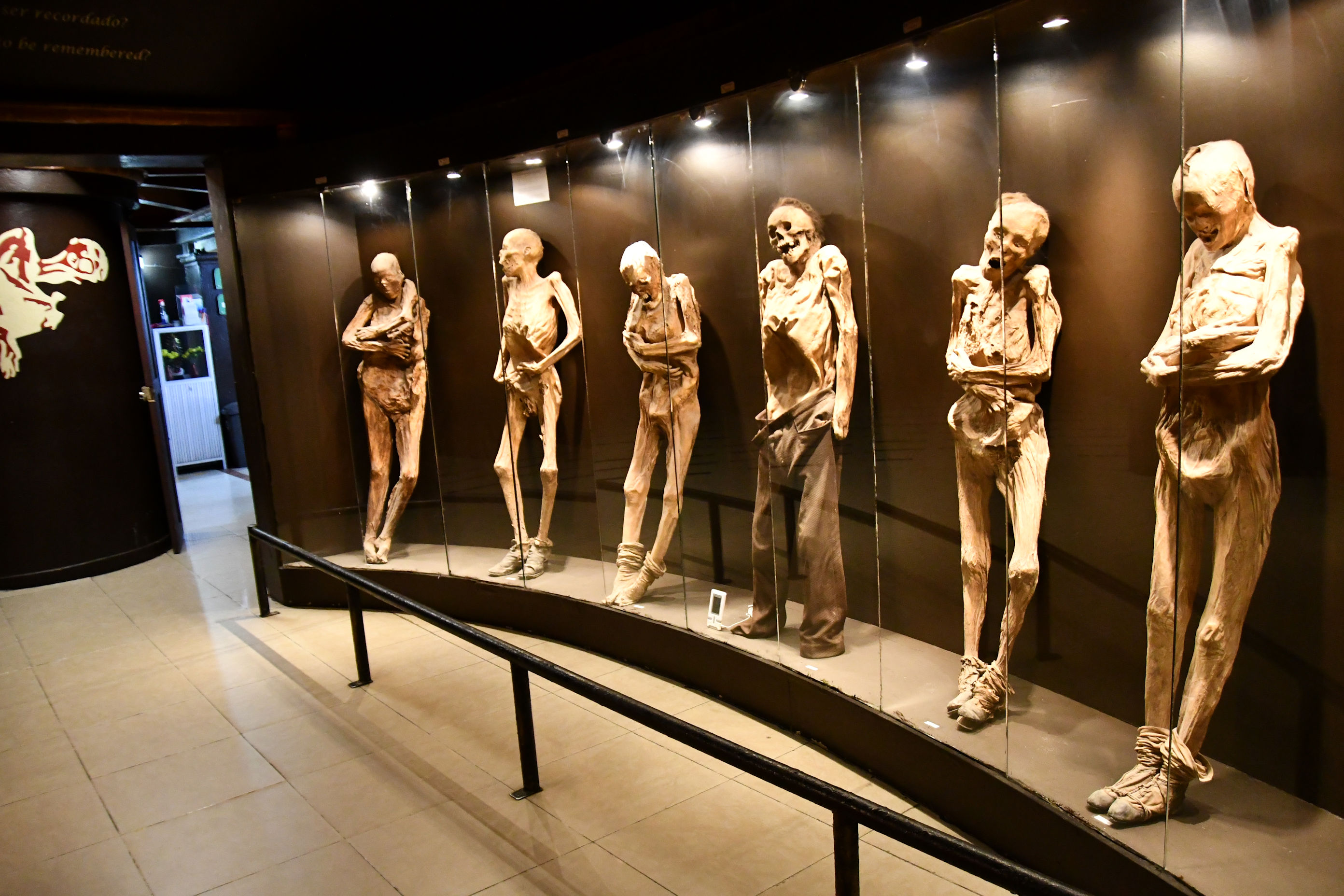
Pedro’s father owned a funeral home, so he knows a lot about how the mummies came to be in the museum. I feel so fortunate to have learned about it originally in that way, instead of getting all the incorrect details from the various sources that attempt to explain. For one thing, it might be obvious if you think about it, but I did not see it mentioned anywhere that only unclaimed bodies go to the museum. The cemetery attempts to contact the family, and only when no one claims the body is a mummy kept.
Originally, the mummified bodies were kept in an underground ossuary. It’s likely that there was never an intent to display them for the public. With time there were multiple mummies. People found out and snuck into the catacombs without official permission to view the bodies. It is possible that cemetery caretakers were accepting bribes to let people in. It was only after this had been happening for some time that the museum was opened in 1969 to display the mummies. In 2007 the museum was renovated to the version I will show you today. There are currently hopes to renovate once more, to build a better space and to provide more context and dignity to the displays.

Another piece of incorrect data all over the place is a curiously specific description of how they are preserved due to the chemical makeup of the soil. This is totally wrong!! On a placard I read in the museum itself, the cause is described as being due to the sealed crypts interruption normal decomposition processes.
I think I figured out why this erroneous explanation got out there: in an expired version of the Mummy Museum website I found through a service called the Wayback Machine, a description is posted under the headline “What are mummies?” They spend a whole paragraph talking about specific soil content that can create natural mummies. Two paragraphs later, it mentions quite casually that these particular mummies were formed by lack of oxygen and humidity. My guess is that lazy researchers only got as far as the first part, or didn’t fully grasp the second part. After that, many lazy researchers copied the incorrect information from the first incorrect researcher (take note Wikipedia editors!).


In any case, the state of mummification of these bodies is due to being buried in crypts above ground. The crypts are sealed, and without exchange of oxygen and lack of any humidity, conditions are possible for natural mummification. All of the mummified bodies that are exhibited in the Mummies Museum of Guanajuato come from the adjacent Panteón Santa Paula, the municipal cemetery. Nearly all of the interred at that cemetery are in crypts in the walls, and not in the soil. In this particular cemetery, the crypts are also exposed to the heat of the sun, which rapidly dehydrates the corpses. Out of the 111 mummies in the collection, 110 of them are from wall crypts, so how could the content of the soil be the cause of their mummification? It could not.
Despite that disclaimer, there is actually one mummy in the museum that was exhumed from soil. The sign posted with this body has visitors take note of the condition of the body compared to the others, in order to get a sense of what a difference is made when there is oxygen and humidity. The condition is not as good, as the others on display, I agree. However, I hesitate to say that means anything, since we have not been given a good look at all the bodies exhumed, just the ones impressive enough to be in a museum. It’s not a fair comparison.


I read somewhere that in the early days, visitors swiped name tags as souvenirs, and now no one knows who most of these people were. I can’t verify that story. Today there is a study underway by National Institute of Anthropology and History (INAH) to identify the bodies with forensic methods like DNA and dental tests, in hopes of giving them their identities back.


It’s tempting to imagine that these faces are twisted and gape-mouthed in horror from some shocking death, or from being buried alive. It has been explained as the result of jaw muscles slackening after death and deterioration.

There is one mummy with a placard that states the museum curators believe she was buried alive. However, I read an article about forensic anthropologists currently working on this collection and they said that there is no scientific evidence that this is the case. Her arms appear thrown up, and some descriptions say she is biting her arm and was found face down in an attempt to push off the top of the casket with her back. All this drama is likely to bring more visitors, but so far evidence does not prove any of this.
The scientists also found other fascinating information: that two infants in the museum appear to have been embalmed. This was a completely surprise and a mystery to everyone so far, so I will not comment on it farther. But it looks like with continued study, there are more mysteries to unravel here.


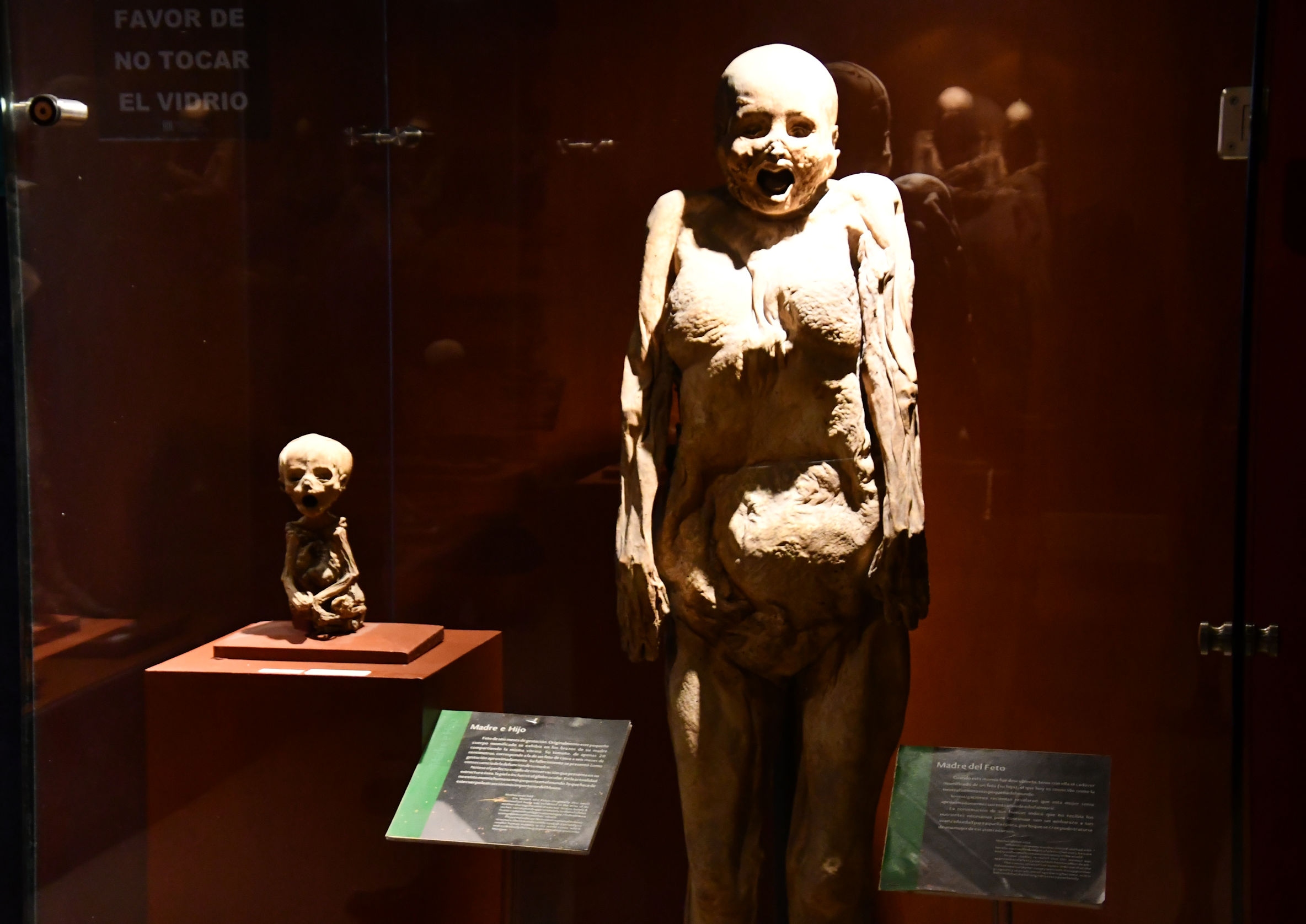
One of the most famous mummies in the museum is identified as the smallest human mummy in the world. It’s mother died, and the fetus died as a result. They are separated, but side by side here.
We spent at least an hour there, moving more slowly than the other visitors, who zoomed through taking shots with their phones and going on to the next display. At the end there is a very small and tacky gift shop. Outside is a neglected part of town with graffiti and disrepair. I am pleased to know that there are hopes for a higher quality facility in conjunction with some forensic research to answer some questions and bring these people to life.


 Conscious Engagement
Reflecting your earlier observation on the detail of the entrance arch, this is all rather ghoulish by our standards, but you are describing a genuine respect for the dead
I am pleased to hear that this is the sense you get, Derrick. Another article I read quotes a tour guide who brings foreigners to this museum. He said he always takes the time to explain that in Mexico, they have a comfortable relationship with the dead and with death, and their interest remains respectful.
Fascinating! So many death anniversaries for me this month that this somehow fits in. Do you remember the BODIES exhibit several years ago? I went to that by myself and spent hours. Controversary all around both of these things. I get that. Many questions of respect and tradition and cultural appropriateness. I had never heard of this. Thanks for sharing.
Hugs for you while you remember people who have walked on. ❤ Have you ever seen the Disney movie Coco? It is absolutely beautiful (centers on a boy and his relationship with his great-grandmother and great-grandfather) and I think is helpful for me in understanding the different culture in Mexico with the way they think of loved ones who have died, compared to how I was raised. Also, the city of the dead in Coco is modeled after Guanajuato, which is a cool family connection for us.
I DO remember the BODIES exhibit, and also the traveling exhibit, and I always always wanted to see it and was never able to. I am absolutely fascinated and interested in that kind of meticulous examination of the inside of bodies. I do know that many consider that exhibit – and the mummy museum – as controversial and disrespectful. But then, I was trained as an anthropologist and it helps me recall that "disrespectful" isn't a fact, but merely behavior that a group of humans have agreed upon. I like that you are willing to tap into childlike curiosity and wonder, and simply learn and love the human body. I still have hopes to be able to see it one day, or something similar.
I absolutely loved Coco. I’ve seen it twice, in fact. I agree it helped me better understand tradition and it was just so well done. Cool to have that family connection. The controversy around the BODIES exhibit was largely a question of whether families gave permission to have their loved ones uused in this way. They understandably felt exploited. But it was something I’ll never forget for sure.
Interesting. I had no idea there was such a museum. That baby still in her sweet gown got to me. DNA is only going to get better and better as an analyzing tool. Fascinating stuff!
Lenore, a couple of the images got to me, so I can understand. They are still so human, despite being dead for 100 years. I think I would have appreciated much more details about their real life, and I think that is what the hope is for the people who are studying them. They said they hope to find real life relatives, and offer them the chance to reclaim the bodies and re-inter them.
Very interesting!