
Two more landmarks I want to talk about from our trip to Mexico in September are the Alhóndiga de Granaditas (public grain exchange building) and Universidad de Guanajuato (University of Guanajuato).
The Alhóndiga (pronounce it: ah LON diga) is the site of a grisly war battle. This plain and sturdy building looks like some kind of stronghold, and that was part of the intent. It was for grain and corn storage, and inside this building that commodity could be kept dry, but also safe from theft. Its construction lasted from 1798 to 1809, and prior to 1958 when it became a museum, it had been used as a warehouse, military barracks, and a prison. The unexceptional building is famous to locals, and has become a public space. If it wasn’t so important, it probably would have been demolished, either to scavenge the construction stones, or to use the flat land beneath it. The museum was closed the day we were there, but Pedro made sure to take us there and tell us about it while we walked around the outside.

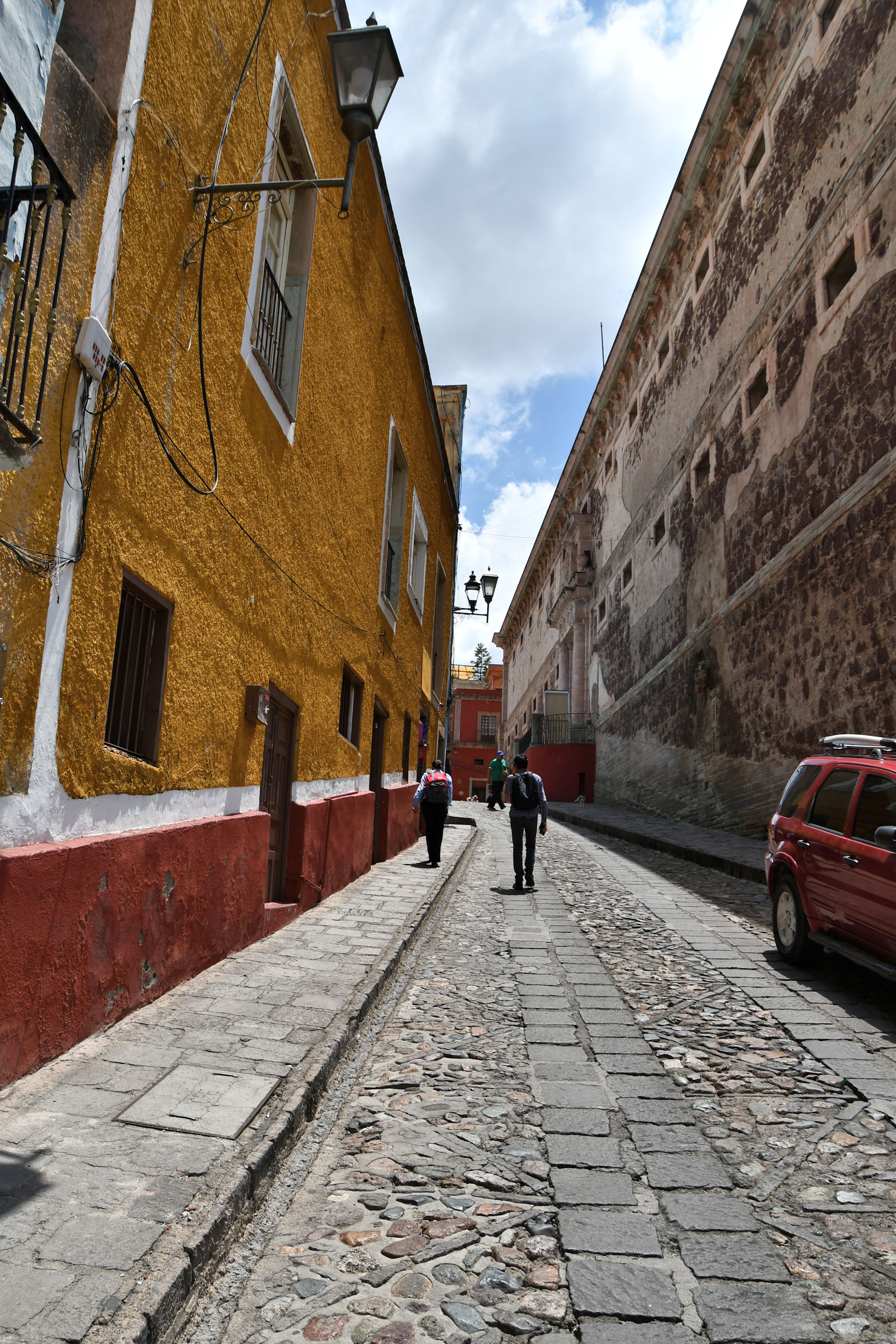
If you have read earlier blog posts, you may recall that in September 1810, Father Miguel Hidalgo y Costilla left the town of Dolores, lead others to revolt against colonial rule. They stopped in Atotonilco, and San Miguel de Allende, before moving on to Guanajuato. The Spanish families living in Dolores ran to Guanajuato seeking safety and shelter, so by the time Hidalgo reached Guanajuato, the Spanish living there knew they were coming and were afraid. In addition to the food already inside, colonists collected valuables (primarily stockpiles of silver from the silver mines) and barricaded themselves inside the grain warehouse – the Alhóndiga – possibly thinking that as long as they refused to surrender, there would be no revolt. The building had thick walls, small windows, and a single door that was easy to defend.

Remember El Pípila? On September 28, 1810, Mexican revolutionaries surrounded the building, but despite numbering in the thousands, it seemed impenetrable. Hidalgo knew that the Mexicans would not have a chance of anything as long as the 300 Spaniards were safe inside. The legend says that El Pípila, the nickname of a strong miner, Juan José de los Reyes Martínez, was chosen. He strapped a flat quarry stone to his back as a shield against gunfire, and managed to get to the massive door. He coated the door in tar and lit it on fire. This allowed the insurgents to break in and slaughter all who were inside, which included Spanish refugees as well as some local Mexican women who had been brought in to cook. Pípila died in the fight. This massacre was the first insurgent battle of the Mexican War of Independence. Now you know why this building is so important. And why Pípila is so important.


The horrific attack is rumored to have kept Father Hidalgo from going on to Mexico City, being afraid the insurgents would commit a similar attack. It may have been his undoing, then, because soon afterward, Hidalgo and the three main leaders of the insurgence, Ignacio Allende, Juan Aldama, and José Mariano Jiménez were killed by the Spanish. In retribution for their crimes, the men were beheaded and their heads hung from the four corners of the Alhóndiga until Mexico gained its independence, ten years later. Maybe their deaths lit a fire beneath the insurgents, for it certainly did not stop them in their quest.


The interior of the building seems much more beautiful than the outside, according to photos I have seen, with a large courtyard surrounded by balconies and pillars for the merchants to do business. It sort of reminds me of the caravanserais I saw in Turkey. On the next visit, I’ll try to get inside the museum, which holds a vast quantity of historical documents as well as some impressive murals.

A few minutes away on foot is Pedro’s old Alma Matter, the Universidad de Guanajuato, or, University of Guanajuato. The school was founded in 1732 and remained part of the church until 1827, when it was run by the state. It became independent in 1945, when it took on the name of “University.” Today it has eleven schools on five campuses. There are multiple museums on campus and it held the first meteorological observatory in the country.
During the War of Independence, Marcelino Mangas, a priest and teacher, along with a group of dedicated students, managed to keep the school functioning when others tried to take over. Mangas is considered to this day to be an important figure in promoting education and uplifting of the youth of Guanajuato. His remains are interred in the old chapel of the College.

When Pedro was a kid, he worked very hard to get an opportunity to attend an elite high school that is part of the University of Guanajuato. To get into the high school, kids had to excel at an achievement test. The high school had a strict dress code, a code of behavior, and a grade point average requirement that all had to be maintained in order for students to be allowed to stay. If a kid graduated from there, they had an especially good chance of being accepted to UG. Pedro hung around with a group of troublemakers for a part of his young life, and on one occasion he was with them when they spray painted a bunch of graffiti. Unfortunately they were caught, and were all scrutinized as students of the prestigious high school. Each of them was expelled except Pedro. He had explained that he had not personally painted graffiti, but had only been with them – and school authorities took his word for it. They said that since it was his first offence, he would get another chance. With all of his troublemaker friends banished to a different high school, Pedro said it was a lot easier after that to stay out of trouble, and he graduated without any further problems.
And, yes, his goal was achieved when he was accepted into the University of Guanajuato. First, he had to take another test. He remembers the test to get into the high school being all day long or maybe two days. He remembers the test to get into the university taking the better part of a week. Many people try multiple times to get high scores on the test and get accepted. There are entire businesses dedicated to helping students prepare for the test. Pedro, my super smart boyfriend, was accepted with his first application without needing professional services. His cohort in the Chemistry department was a class of only 25 students. Below is his diploma when he earned his degree in Chemical Engineering.

(Isn’t he the cutest? He was 25 years old in that photo. *swoon*)


The building on top of the hill in the photo above is a hotel, and it looks like another hotel under construction. Pedro was quite surprised to see them. He said there were always battles from developers who wanted to own that hill and build something there, and the city flatly refused all offers. He thought no one would ever be allowed to build there. My guess is that a sufficient amount of money can make people’s integrity waver.
That night we had visited his brother Victor, who lives with his family in a gorgeous home right smack in the middle of downtown. Victor is an artist, and showed us his work, and his studio. I had been hearing about his artwork for years and was absolutely delighted to meet the man and see examples of what he has created. In my limited Spanish, I tried to tell him that I am also an artist, and I think he was glad to hear some kind of characteristic to ascribe to me. I showed some paintings of mine that I had on my phone. Victor and Mari and their daughter Vere and her two kids were all there and entertained us and shared four different kinds of fruit ice cream. They also showed us the adjacent building that they had made into a hotel that they managed. I decided that when I come back to live with Pedro’s family to learn Spanish, I will ask if I can live here. (wink) As a gift before we left, they gave us some pottery by Gorky Gonzalez, a famous local potter.

I have no photos of their beautiful home, or any of us that night. Sometimes I get too caught up in the moment to remember to take photos, and I think there is some good in that. So I will instead show you photos from another night. Most of Pedro’s siblings and their families were here this time. We all gathered at their brother Miguel’s house. Miguel and his family lives in the US and were not around during our visit, so this was a way to include Miguel and his wife Kate (who happens to be from Portland!) in spirit. This house is used as an Airbnb.


We ate and ate and ate. And after that, it was time to dance. And then it was time to drink. Their brother Jesus is a connoisseur of Mescal, a hard liquor made from agave (a succulent related to yucca). He brought out some of his best stuff and offered it to everyone and emptied a couple of bottles. Then there was a flash thunderstorm and a downpour that sent everyone running inside the house. Then it was time to turn up the music and dance some more.

I have included two videos of us below. They are short, and they are kind of fun. Please enjoy.
The family gave us a ride home when we were all danced out. They dropped us off at the top of the hill by Pípila and waved goodbye. They were smart enough not to try to navigate down the hill in the dark for the second time!


I’ll leave you with one final photo, just because it’s cool. I don’t know how I did this, but I think it’s awesome:


 Conscious Engagement
Another great post! Those are two very impressive buildings and it was great to read about the history. The troublemaker story is a good lesson for teenagers…be careful about who you hang out with. Such a good thing that Pedro wasn’t expelled with the rest. And I luv the last accidental photo. Very cool!
Thank you for such a great comment, Lenore. I thought the same thing about the troublemaker story. We weren’t able to use it on our kids though. His two and my one ended up being so gentle and sweet and had the sweetest friends. All of them nerdy and kind…we were so lucky. He is grateful to this day that he managed to get into such good schools, and stay in them. That last pic was super fun. I love when that kind of thing happens.
I’m thinking of you and trying to get a note written back.
I got it! Thank you, my friend. ❤
Some fascinating history with these excellent photographs. Fun videos with impressive thunderstorm. It is good to live in the moment and forget to photograph.
I’m glad you agree. While I was writing, I was thinking at first that I’m sorry I can’t share the house and the moment and the ice cream with all of you. I wondered how on earth I could have spent so much time there and didn’t take a single photo. Then I realized it was because we were so engaged with the conversation, and the tour of the house, and meeting everyone. And that’s a good thing.
Indeed